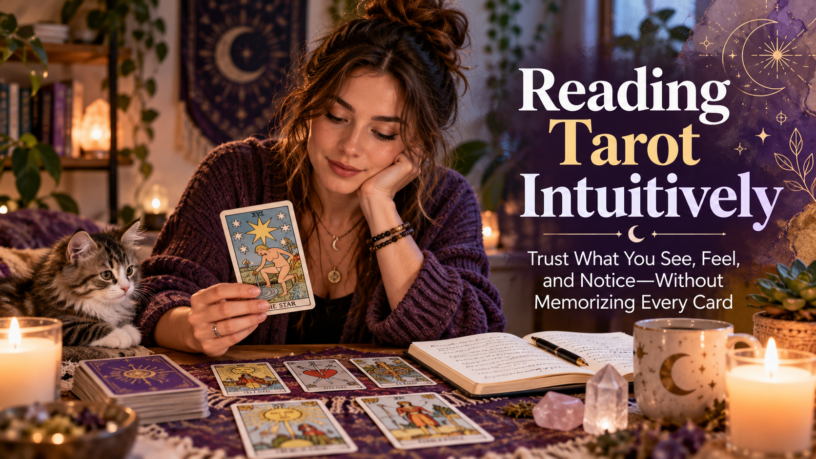



You shuffle the deck.
Pull one card.
Turn it over.
Before you even remember its traditional meaning, something catches your attention.
Maybe it is the expression on a person’s face.
A storm in the background.
The way two figures are standing apart.
A tiny object in the corner.
A color that suddenly feels important.
For a moment, you have a reaction.
Then doubt arrives.
You grab the guidebook.
Search the card online.
Read three different interpretations.
Watch someone explain it in a video.
Twenty minutes later, you have more information—but somehow less confidence in what you originally noticed.
This is one of the biggest obstacles beginners encounter when reading tarot intuitively.
They assume a tarot reading becomes legitimate only after every card meaning has been memorized.
But tarot can be approached differently.
Traditional meanings provide structure. Imagery provides context. The question provides direction. Your own observations help connect those pieces.
You do not have to choose between knowledge and intuition.
The useful skill is learning how to let them work together.
Tarot Is Not a Vocabulary Test
A standard tarot deck contains 78 cards.
If you believe every card has one correct definition, learning tarot quickly starts to resemble studying for an exam.
The Fool equals this.
The Tower equals that.
Three of Swords means this.
Queen of Pentacles means that.
Then reversals enter the picture.
Different spreads change context.
Cards appear beside other cards.
Suddenly, memorizing one sentence per card is not enough anyway.
That is because tarot cards are not single-definition vocabulary words.
They are symbolic images capable of expressing different themes depending on context.
Traditional Meanings Still Matter
Reading intuitively does not mean ignoring established tarot symbolism.
Traditional card meanings can provide a foundation.
They help you understand recurring themes within the Major Arcana, Minor Arcana, suits, numbers, and court cards.
Without any foundation at all, interpretation can become completely arbitrary.
But traditional meaning works better as a framework than a cage.
Think of it like learning a language.
Vocabulary matters.
Grammar matters.
But eventually, you need to stop translating every sentence word by word and start understanding what is being communicated.
Start With What You Actually See
Before opening the guidebook, look at the card.
Not for what you think you are supposed to see.
Look at what genuinely catches your attention.
Who is present?
What are they doing?
Where are they looking?
What objects appear?
What seems to be happening?
What looks calm?
What looks unstable?
What feels distant?
What appears protected?
You are not trying to prove anything.
You are collecting observations.
That distinction matters.
Description Comes Before Interpretation
Suppose you pull a card showing someone standing alone while several figures appear farther away.
Do not immediately decide:
“This means isolation.”
Start with description.
One person is separated from the others.
The person is facing away.
The group is in the distance.
There is space between them.
Now interpretation can begin.
Could the separation represent independence?
Loneliness?
Perspective?
A deliberate boundary?
Leaving something behind?
The image creates possibilities.
The question helps narrow them.
Ask What Your Attention Chose First
A tarot card may contain many symbols.
Yet one detail often becomes noticeable before the others.
Pay attention to that.
If you immediately notice the person’s hands, ask why.
If your eyes go to the sky, notice it.
If everyone else talks about the central figure but you cannot stop looking at the small animal beside them, explore that detail.
When reading tarot intuitively, the first observation can sometimes provide a useful entry point into the card.
It does not automatically become the entire interpretation.
It gives you somewhere to begin.
Your Question Changes the Meaning
Imagine pulling the same card for three questions.
“What should I understand about my career?”
“What is affecting this friendship?”
“What habit should I examine?”
The card has not changed.
The context has.
A symbol suggesting patience may relate to professional timing in one reading, emotional space in another, and delayed gratification in the third.
This is why memorized definitions can feel insufficient.
Tarot interpretation happens between the card and the question.
Not inside the card alone.
Ask Better Questions
Questions shape readings.
Compare:
“Will my life get better?”
with:
“What part of my current situation needs more attention?”
The second gives you something to explore.
Similarly:
“Will I get the job?”
can become:
“What can I focus on while pursuing this opportunity?”
You are moving from passive prediction toward reflection and action.
That often makes tarot more useful because the reading becomes something you can engage with rather than simply wait for.
One Card Is Enough to Practice
Beginners often jump directly into large spreads.
Ten cards.
Different positions.
Reversals.
Clarifiers.
Then another clarifier for the clarifier.
Now there are fourteen cards on the table and no idea what any of them are saying.
Start smaller.
Pull one card.
Spend time with it.
Describe it.
Connect it to one question.
Write a few sentences.
One-card readings create enough complexity to practice interpretation without overwhelming yourself.
Try a Three-Step Reading
A simple exercise can make reading tarot intuitively much easier.
First, describe what you see.
Second, write what the image makes you think or feel.
Third, connect that observation to the question.
For example:
“I notice the figure is looking backward.”
“This makes me think about hesitation or attention being directed toward something that already happened.”
“In relation to my question, maybe I am spending too much energy reviewing an old decision instead of deciding what happens next.”
Notice the language.
“Maybe.”
“Could.”
“Suggests.”
Tarot reflection does not require pretending uncertainty does not exist.
Your First Interpretation Does Not Have to Be Brilliant
Beginners often freeze because they want every reading to sound profound.
It does not need to.
Sometimes the useful observation is simple.
“You seem tired.”
“This situation may need patience.”
“There are too many competing priorities.”
“You may already know what boundary you want.”
Simple does not mean meaningless.
Trying too hard to create a dramatic interpretation can make readings less connected to the actual cards.
Stop Trying to Sound Like a Tarot Reader
You do not need mystical vocabulary.
You do not need to say:
“The universe is revealing an energetic portal of transformation.”
unless that language genuinely fits your personal practice.
You can say:
“This card makes me think you are avoiding a decision because both options involve giving something up.”
Clear language often produces clearer reflection.
Tarot does not become deeper simply because the explanation sounds mysterious.
Use the Guidebook After Your Own Observation
Guidebooks are valuable.
The timing matters.
Try spending a minute with the card before reading its entry.
Write your interpretation first.
Then compare.
What did the guidebook emphasize?
What did you notice independently?
Where do they overlap?
What did you miss?
Over time, this process teaches traditional meanings without training you to immediately outsource every interpretation.
Do Not Panic When Your Interpretation Differs
You pull a card traditionally associated with celebration.
But something about the image feels uncomfortable.
Does that mean you are wrong?
Not necessarily.
Return to the question.
Maybe celebration is relevant.
Maybe the card highlights social pressure.
Maybe the surrounding cards change the emphasis.
Maybe your reaction is revealing something about how you personally relate to the situation.
The goal is not automatically choosing your interpretation over the traditional one.
Explore the tension between them.
That tension can be informative.
Context Matters More Than Isolated Keywords
Memorization often creates readings like this:
Card one: change.
Card two: conflict.
Card three: success.
Okay.
But what does that actually mean together?
Instead of treating each card independently, look for relationships.
Are figures facing toward or away from each other?
Do several cards suggest movement?
Are many cards passive?
Do similar colors appear?
Are particular suits dominating?
Does the emotional tone shift across the spread?
The reading exists between the cards too.
Read the Spread Like a Story
Imagine three cards representing:
Where you are.
What is challenging you.
What could help.
Do not interpret them as three separate encyclopedia entries.
Connect them.
Perhaps the first shows stability.
The second introduces disruption.
The third suggests adaptation.
Now you have movement:
Something familiar is being challenged, and flexibility may matter more than trying to restore everything exactly as it was.
The cards begin to form a narrative.
Notice Repetition
Patterns deserve attention.
Several Cups may point toward emotional or relational themes.
Multiple Pentacles may direct attention toward practical matters, resources, work, or stability.
Repeated numbers may create another layer to explore.
Several court cards can shift attention toward personalities, roles, or ways of behaving.
You do not need to force meaning into every pattern.
Simply notice what repeats.
Patterns can help organize a reading when individual cards feel disconnected.
Court Cards Do Not Have to Represent Literal People
Beginners often see a King, Queen, Knight, or Page and immediately search for a specific person.
Sometimes that interpretation may fit.
But court cards can also represent:
A role.
A behavior.
A quality.
An approach.
A developmental stage.
Instead of asking only:
“Who is this?”
Try:
“What way of behaving does this card represent?”
That question can make court cards much easier to work with.
Reversals Are Optional
You do not need reversed cards to be a legitimate tarot reader.
Some people use them.
Others do not.
If you are already struggling to learn upright meanings, adding another layer immediately may create unnecessary confusion.
You can begin without reversals.
If you eventually introduce them, avoid assuming every reversed card simply means the opposite of its upright meaning.
A reversal might suggest blocked, internalized, delayed, excessive, weakened, or reconsidered energy depending on your system.
Choose a method and practice consistently.
Do Not Pull Endless Clarifiers
You pull a card you dislike.
So you pull another.
That one is confusing.
Another.
Still uncomfortable.
Another.
Eventually, you have enough cards to construct almost any answer you wanted.
Clarifiers can be useful when a specific part of a reading genuinely needs context.
But repeatedly drawing cards until the reading feels reassuring can turn interpretation into answer shopping.
Sometimes the better move is to sit with the uncomfortable card.
Learn to Say “I Don’t Know Yet”
Not every card will immediately make sense.
That is normal.
Write it down.
Return later.
You may understand the connection after the situation develops or after you gain more experience with the card.
Forcing an interpretation simply because a card is on the table can create unnecessary certainty.
“I don’t know what this means in this context yet” is a valid reading note.
Keep a Tarot Journal Without Making It Complicated
You do not need a beautiful journal filled with elaborate illustrations.
A simple format works:
Date.
Question.
Card or spread.
First observations.
Interpretation.
Later reflection.
The final section is especially useful.
Return after a few days or weeks and ask:
What did I understand correctly?
What did I exaggerate?
What did I completely miss?
Did the card mean something different than I expected?
This turns experience into learning.
Record Your First Reaction Before Researching
When journaling, write your first impression before checking external meanings.
Otherwise it becomes difficult to distinguish your own observation from something you just read.
Even two sentences are enough.
“Feels defensive.”
“My attention goes immediately to the closed door.”
Then research the card.
Over time, you will begin recognizing which symbols consistently speak to you.
Build Personal Associations Carefully
Suppose dogs repeatedly appear in your deck and you personally associate dogs with loyalty.
That association can become part of your tarot vocabulary.
But personal symbolism should still be used thoughtfully.
Someone else might associate dogs with fear because of past experiences.
Context matters.
Personal associations enrich interpretation when they complement the card rather than completely replacing everything else.
Intuition Is Not the Same as Certainty
This distinction is important.
Feeling strongly about an interpretation does not make it objectively true.
Intuition can be useful for reflection.
It can also be influenced by expectations, fears, hopes, and biases.
That is why reflective language matters.
Instead of:
“This person is definitely lying.”
Consider:
“This reading makes me wonder whether trust or missing information is part of the issue.”
The second interpretation creates space for thought without pretending a card proved something it cannot verify.
Be Especially Careful When Reading for Other People
When someone asks you for a reading, your words can carry more weight than you realize.
Avoid presenting interpretations as guaranteed facts about health, legal outcomes, finances, pregnancy, death, or another person’s hidden intentions.
Tarot can support reflection.
It should not replace qualified professional advice or factual evidence when real-world decisions require them.
The more serious the situation, the more important that boundary becomes.
Avoid Turning Tarot Into Surveillance
“Is my partner cheating?”
“What is my coworker secretly planning?”
“What does my ex think about me every night?”
These questions can pull readings toward claims about another person’s private thoughts or actions.
A more grounded approach brings the focus back to what you can actually examine.
“What is making me feel uncertain in this relationship?”
“What communication do I need?”
“What boundary would help me?”
“What information should I seek directly?”
Tarot becomes more actionable when the reading returns agency to the person asking the question.
Do Not Ask the Same Question Twenty Times
You do a reading.
You dislike the answer.
Shuffle again.
Ask differently.
Pull again.
Still uncomfortable.
Try another deck.
At some point, you are no longer exploring the question.
You are negotiating with the cards.
Repeated readings can increase confusion because every new spread introduces more material to interpret.
If you have already asked clearly, give the reading some space.
Your Mood Can Affect What You Notice
Read the same card while calm and while extremely anxious.
You may notice completely different details.
That does not make intuition useless.
It means self-awareness matters.
Before a reading, ask:
What am I hoping the cards say?
What am I afraid they will say?
Am I trying to understand something or receive reassurance?
Knowing your emotional position can help you interpret more carefully.
Create a Small Pre-Reading Ritual
A ritual does not need to be elaborate or supernatural.
Its purpose can simply be helping your attention transition.
Put the phone away.
Clear a small space.
Take a few slower breaths.
Write the question.
Shuffle.
Begin.
The repetition tells your mind:
Now I am paying attention to this.
That can make the reading feel more deliberate and less like impulsively pulling cards whenever anxiety appears.
You Do Not Need Ten Decks
A beautiful new deck can be exciting.
But switching decks constantly can make learning harder because each artist uses different imagery and symbolism.
Spending sustained time with one deck helps you become familiar with its visual language.
You begin recognizing small details.
Recurring symbols.
Color choices.
Characters.
Patterns.
A deck becomes easier to read partly because it becomes familiar.
Study One Card Without Memorizing It
Choose one card.
Instead of trying to memorize five keywords, spend several minutes looking at it.
Ask:
What happened immediately before this scene?
What might happen next?
What does the character want?
What is the strongest emotion?
What is missing?
What would change if one symbol disappeared?
This builds interpretive flexibility.
You are learning to interact with the card rather than simply recall a definition.
Compare the Same Card Across Decks
Once you know your main deck reasonably well, comparing artwork can deepen understanding.
Look at the same card in several decks.
What remains consistent?
What changes?
Which symbols are emphasized?
How does the emotional tone shift?
This can help separate the broader archetype of a card from one artist’s particular interpretation.
Practice With Ordinary Questions
Not every tarot session needs to involve life-changing decisions.
Practice with lower-pressure prompts.
“What energy should I bring into today’s work?”
“What might help me approach this creative project?”
“What should I pay attention to this weekend?”
Ordinary questions give you room to experiment without feeling that every interpretation carries enormous consequences.
Skill grows through repetition.
Read Old Spreads Again
One of the best learning exercises happens after time has passed.
Open your journal and revisit an old reading.
Do not ask whether the cards magically predicted every event.
Instead ask:
How did I interpret them then?
What assumptions did I make?
Which observations were useful?
What became clearer later?
Would I read the same cards differently now?
This shows your growth more clearly than constantly testing yourself on definitions.
You Are Building a Relationship With Symbols
The longer you work with tarot, the less individual cards feel like isolated pieces of information.
You begin recognizing families of ideas.
Movement.
Stagnation.
Choice.
Attachment.
Conflict.
Rest.
Beginnings.
Completion.
Uncertainty.
Connection.
The deck becomes a symbolic language.
That is why fluency develops gradually.
You are not memorizing 78 passwords.
You are learning how themes interact.
Confidence Comes From Practice, Not Perfect Recall
You will forget card meanings.
Experienced readers still look things up.
You will occasionally pull a card and feel completely blank.
That does not erase everything you have learned.
Confidence develops from repeatedly going through the process:
Observe.
Interpret.
Connect.
Reflect.
Check.
Learn.
Then do it again.
Over time, the guidebook becomes a resource rather than a lifeline.
Conclusion
Reading tarot intuitively does not require throwing away traditional card meanings, and it does not require memorizing every possible interpretation before you are allowed to begin.
Start with the card in front of you.
Describe what you actually see.
Notice which symbol catches your attention.
Consider your emotional reaction.
Then connect those observations to the question before checking the guidebook for additional context.
Traditional meanings give tarot structure. Personal observation gives it flexibility. The question gives it direction.
Keep your readings small while learning. Journal your first impressions. Look for relationships between cards instead of treating each one as an isolated definition. Use clarifiers sparingly, and allow yourself to admit when a card does not make sense yet.
Most importantly, leave room for uncertainty.
Tarot can be a tool for reflection without becoming a source of absolute claims about the future or other people’s private thoughts.
You do not need to know every card by heart before you start reading.
You need enough curiosity to look carefully, enough structure to stay grounded, and enough practice to gradually trust your ability to make connections.
The goal is not to find the one “correct” sentence hidden inside every card.
It is to learn how to have a more thoughtful conversation with what you see.
