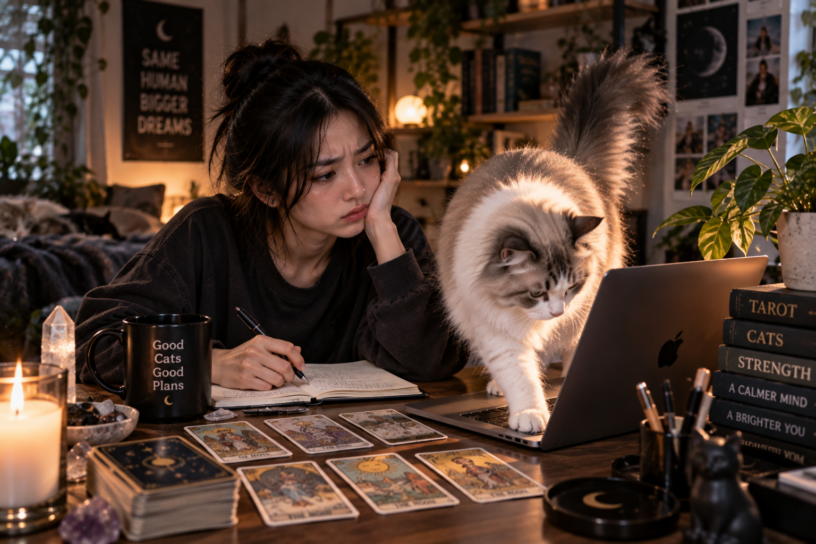



You have been moving around the house for the last hour, and your cat has barely acknowledged your existence.
Then you sit down.
Maybe you open a journal. Perhaps you spread a tarot deck across the table, start reading a book, unroll a yoga mat, or finally open the laptop to finish something that requires concentration.
Within minutes, the cat appears.
A paw lands directly on the page. A furry body settles across the keyboard. One card gets pushed away from the rest of the deck. If you move everything to create more space, the cat somehow interprets that as an invitation to occupy the newly cleared area.
It can feel almost deliberately timed.
But understanding why cats interrupt you when you’re busy usually requires much less mystery than it appears. Cats are extremely responsive to routines, movement, interesting surfaces, changes in human attention, and opportunities to interact with their environment.
Your Attention Has Suddenly Become Predictable
When you are walking through the house, cooking, cleaning, or moving between rooms, you are difficult to predict.
Your location keeps changing.
Then you sit at a desk or on the floor and remain there.
From a cat’s perspective, this creates a much easier opportunity for interaction. You are now stationary, accessible, and likely to remain in the same place for a while.
The timing can make it seem as though your cat specifically objects to your activity.
In reality, your stillness may simply have made you more interesting.
Cats Learn Your Daily Patterns
Cats can become remarkably familiar with household routines.
They notice when people wake up, prepare food, return home, settle onto the couch, or begin getting ready for bed.
Your personal activities can become part of that pattern.
If you regularly journal after making coffee, stretch before bed, or work at the same desk every afternoon, your cat may begin associating those moments with your availability.
Eventually, the appearance of the notebook itself may become a cue.
To you, the notebook means focus time.
To the cat, it may mean: “The human is about to sit here for the next thirty minutes.”
New Objects Immediately Change the Environment
Put an empty piece of cardboard on the floor and some cats will investigate it almost immediately.
Open a book and suddenly there is a new surface.
Spread several cards across a table and you have created multiple small objects that move when touched.
Unroll an exercise mat and a previously ordinary section of floor becomes different.
Cats frequently investigate changes in their environment. An object does not need to be expensive, interactive, or designed for pets to become interesting.
Sometimes novelty itself is enough.
Your Tarot Deck Is Full of Moving Objects
To a person, a deck of tarot cards may be a tool for reflection, symbolism, or creative thinking.
To a cat, it is also a collection of lightweight rectangular objects that slide beautifully across a smooth table.
Shuffling creates movement and sound.
Dealing cards introduces one object after another.
Your hands repeatedly move across the surface.
Those characteristics can make the activity visually interesting regardless of what the cards mean to you.
So when a paw suddenly sends The Hermit sliding under the couch, you probably do not need to interpret it as a profound message from the universe.
Your cat may simply have discovered excellent physics.
Books Create an Almost Perfect Cat Situation
Reading creates another combination cats may find attractive.
You become quiet.
You stay in one position.
Your hands make small movements.
A large flat object sits directly in front of you.
Better yet, that object clearly has your attention.
A cat sitting on the book immediately enters the center of the activity.
This does not require the cat to understand what reading is. It only requires noticing where your eyes and hands keep going.
The Laptop Has Several Things Working in Its Favor
Laptop interruption is practically its own category of cat behavior.
The keyboard is elevated slightly from the desk.
Your hands are constantly moving across it.
The screen creates light and movement.
Some devices also produce warmth during use.
Most importantly, you repeatedly direct your attention toward the exact area where the laptop sits.
If your cat wants proximity, placing itself between you and the object receiving your attention is remarkably effective.
You might call it sabotage.
From the cat’s perspective, it worked.
Attention Can Reinforce the Behavior
Imagine what happens when your cat walks across the keyboard.
You immediately react.
You say the cat’s name.
You touch them.
You pick them up.
Maybe you laugh, take a photo, or stop working entirely.
From a behavioral perspective, the interruption produced a large amount of attention.
If similar interactions happen repeatedly, the cat can learn that entering the workspace is an effective way to engage with you.
Even being gently moved away can still provide interaction.
This does not mean the cat is consciously developing a sophisticated strategy to ruin productivity. Behavior can simply become more likely when it consistently produces an interesting result.
“Negative” Attention Is Still Interaction
Humans often distinguish between positive and negative attention.
Cats do not necessarily interpret every interaction through the same framework.
You may say, “No, get off the keyboard,” while looking directly at the cat and moving them with your hands.
That is still a social event.
For a cat that was previously watching you stare silently at a screen, the interruption successfully changed the situation.
If you want a behavior to decrease, consistency matters more than dramatic reactions.
Sometimes They Simply Want the Best Spot
Not every interruption is really about you.
Your journal may be sitting in the patch of sunlight.
The laptop may be warm.
The yoga mat may have a texture your cat enjoys.
The chair beside you may provide a better view of the room.
Humans naturally interpret behavior socially because we are involved in the scene. But cats also make choices based on temperature, texture, height, visibility, security, and comfort.
The place where you happen to be working may simply be excellent real estate.
Why Does the Cat Sit on the Exact Thing You’re Using?
This is what makes the behavior feel intentional.
There is an entire desk available, yet the cat chooses the notebook.
The whole floor is empty, yet they lie across the exercise mat.
One explanation is simple: the object you are using is where the activity is happening.
Your hands touch it.
Your eyes repeatedly return to it.
Objects are moving around it.
By positioning themselves there, cats enter the most active part of the environment.
The location has effectively been highlighted by your own behavior.
Your Scent May Make Personal Objects Familiar
Objects you handle frequently can carry familiar household scents.
Blankets, clothing, pillows, chairs, and other personal items may therefore be comfortable places for a cat to investigate or rest.
This is another reason the objects around your routine can become appealing.
The exact importance of scent varies with the situation, so there is no need to explain every laptop invasion as an emotional declaration.
But familiar scent is one part of how cats experience their environment.
What looks like a random notebook to them may not smell entirely random.
Quiet Rituals Can Become Shared Routines
Something interesting happens when the same interruption occurs for months.
It can stop feeling like an interruption.
Perhaps every morning you journal while your cat sleeps beside the notebook.
Maybe you read at night while the cat occupies the other half of the couch.
You stretch while they sit at the edge of the mat.
What began as the cat investigating your routine becomes part of the routine itself.
Households naturally develop these small patterns.
They may not have formal meaning, but repetition gives them familiarity.
This Is Why Cats Fit So Easily Into Personal Rituals
People often imagine rituals as elaborate or spiritual activities.
But a ritual can also be a simple repeated sequence that marks a transition.
Making coffee before writing.
Lighting a candle before reading.
Shuffling cards while thinking through a question.
Stretching after work.
A cat appearing during the same sequence adds another predictable element to the environment.
The animal does not need to understand the symbolic meaning of what you are doing for its presence to become associated with the experience.
Be Careful About Turning Normal Cat Behavior Into Mysticism
Cats have been surrounded by symbolic interpretations for centuries.
Their quiet movement, nighttime activity, intense staring, and unpredictable behavior make them easy subjects for supernatural stories.
That can be fun within art, mythology, tarot aesthetics, or personal symbolism.
But it is useful to separate symbolism from claims about actual feline behavior.
A cat choosing one tarot card over another does not demonstrate that the animal understands divination.
A cat staring into an empty hallway does not automatically mean something supernatural is present.
You can enjoy the symbolism without pretending ordinary animal behavior has been scientifically established as paranormal perception.
Your Cat Can Still Make the Ritual Meaningful
Removing supernatural claims does not make the experience less valuable.
Suppose your cat always sits beside you while you journal.
That presence might make the routine feel calmer or more familiar.
Years later, seeing a photograph of that notebook with a paw resting beside it could carry enormous emotional meaning.
The meaning comes from your relationship and memory.
Something does not need to be supernatural to become symbolic.
Ordinary routines often become important precisely because they are repeated so many times.
Give Them an Alternative Place to Participate
If you enjoy having your cat nearby but would prefer to keep paws off the keyboard, create another attractive location.
A small bed, folded blanket, box, or chair beside the workspace may provide an alternative.
Placement matters.
A perfect cat bed across the room may be less appealing than a plain box thirty centimeters from your elbow because the cat wants proximity to the activity.
The goal is not necessarily to remove the cat from the environment.
It is to provide a location where being involved does not require sitting directly on your work.
Reward the Location You Actually Want
If your cat chooses the nearby bed instead of the keyboard, that is the behavior worth making pleasant.
Attention, gentle interaction, or another appropriate reward can help make the alternative spot valuable.
Meanwhile, keep responses to unwanted interruptions calm and consistent.
Repeatedly turning keyboard invasions into an exciting game can work against what you are trying to teach.
The household environment is constantly teaching animals which behaviors lead to interesting outcomes.
Often we teach those lessons without realizing it.
Protect Objects That Could Be Unsafe
Not every object involved in a personal ritual is appropriate for pets.
Candles are an obvious example.
A curious cat near an open flame can knock something over, burn fur, or create a fire risk. Incense and essential-oil products also require caution because some substances and exposure methods can be problematic for cats.
Small crystals, strings, jewelry, herbs, decorative pieces, and other objects may become choking or ingestion hazards depending on their size and material.
Aesthetic setups should still be pet-safe.
Your cat does not understand that an object is decorative and therefore “not supposed to be touched.”
Exercise Equipment Needs Attention Too
Cats appearing during workouts can be funny until heavy equipment starts moving.
A cat should not be allowed to wander beneath a loaded barbell, adjustable bench, moving weight stack, or dumbbells being placed on the floor.
Before a heavy set, know where the animal is.
If necessary, keep the cat outside the training area temporarily.
Strength training and cat companionship can coexist.
They simply should not occupy the exact same square meter during a heavy lift.
Learn the Difference Between Social Behavior and a Real Change
A cat interrupting your normal routine is usually not concerning by itself.
But sudden behavioral changes deserve more attention.
If a normally independent cat becomes unusually clingy, vocal, restless, withdrawn, aggressive, stops eating normally, changes litter-box habits, or shows other significant changes, do not automatically interpret it as personality or spiritual sensitivity.
Behavioral changes can sometimes accompany stress, environmental changes, or health problems.
If something seems genuinely unusual or persistent, a veterinarian is the appropriate source of guidance.
Sometimes the Cat Is Telling You Something Very Ordinary
There is another possibility when your cat refuses to leave you alone.
Check the basics.
Is the water available?
Is the litter box accessible and reasonably clean?
Is it near the normal feeding time?
Has the cat had opportunities for play and interaction?
Humans can become so absorbed in work that a very ordinary request starts looking mysterious.
Before analyzing the universe, check the food bowl.
Planned Play Can Reduce Random Interruptions
Cats benefit from appropriate opportunities to play and express natural behaviors.
If your cat becomes particularly active during the exact period when you need to concentrate, a short interactive play session beforehand may help in some households.
This is not a guaranteed “make my cat leave me alone” button.
The goal is simply to include the animal’s needs in the household routine rather than expecting hours of inactivity whenever humans become busy.
A predictable rhythm can benefit both sides.
There Is Something Useful About the Interruption
Not every interruption needs to be optimized out of life.
You have been staring at the screen for ninety minutes.
A cat suddenly walks across the desk.
You stop.
Your eyes leave the monitor. Your posture changes. You notice the room again.
The cat did not consciously prescribe a productivity break.
But the interruption can still remind you that attention has become extremely narrow.
Sometimes a thirty-second pause is not the disaster our productivity mindset makes it seem.
But Boundaries Are Still Fine
Loving your cat does not require allowing them to participate in everything.
You can move them away from food preparation.
You can protect a fragile card collection.
You can keep them out of the room during heavy lifting.
You can close the office door when uninterrupted concentration is genuinely necessary.
Boundaries are part of designing a shared environment.
The objective is not choosing between your routine and your cat.
It is creating routines that realistically account for both.
The Cat Is Not Ruining the Ritual—It May Be Becoming Part of It
There is a funny transformation that happens over time.
At first, the cat lying across your journal feels like a disruption.
Then you start automatically leaving a blank space beside it.
The cat sits there.
Months pass.
Eventually, the image of journaling without a sleeping cat nearby feels incomplete.
This is how ordinary domestic routines accumulate meaning.
Not because every action carries a hidden message, but because repetition connects places, objects, animals, and people into memories.
Conclusion
Understanding why cats interrupt you when you’re busy usually does not require assuming that cats dislike productivity or possess a mysterious ability to detect the exact moment humans need concentration.
When you sit down to read, journal, work, stretch, or shuffle a tarot deck, you become stationary and predictable. You also introduce interesting objects, movements, surfaces, sounds, and opportunities for interaction into the cat’s environment.
Your response matters too. If every interruption immediately produces conversation, touch, laughter, or play, the behavior can become an effective way for the cat to engage with you.
Create an appealing nearby spot when you want companionship without interference, keep potentially dangerous ritual or exercise objects safely away, and pay attention when behavior changes significantly rather than interpreting everything symbolically.
And if your cat walks across the tarot spread and sends one card flying onto the floor?
You are free to find the moment meaningful.
Just remember that sometimes the universe is sending you a sign—and sometimes a cat simply saw a small object that looked extremely fun to slap.