
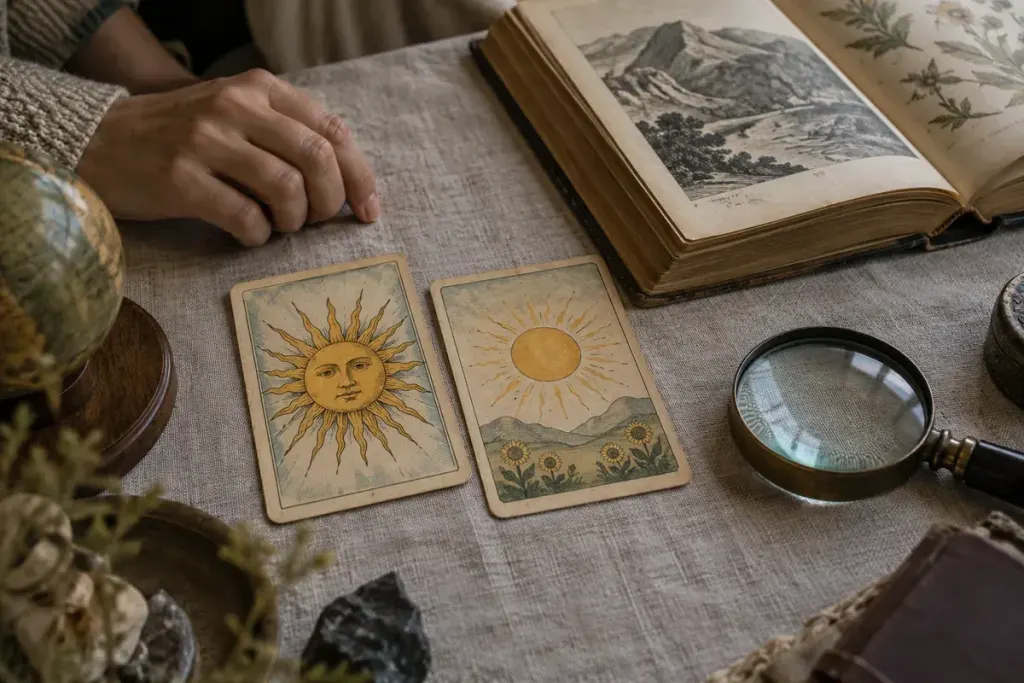
Two decks can include a card with the same name and leave you with quite different impressions. One may feel spacious and playful; another may appear formal or quiet. Comparing them through a single symbol can reveal more than trying to memorise a long list of meanings.
Choose one feature that appears in both images—a sun, a river, a doorway or an animal. This is a visual study, not a test of which deck is spiritually correct. You are looking at how an artist builds a scene and how you respond to it.
Record the deck before describing the symbol
Note the deck title, artist, edition if known and card name. Those details prevent notes from different versions becoming mixed together. If you are looking at a museum image rather than a card you own, save the collection link and the identifying information provided there.
The V&A’s illustrated history shows cards from different periods and makers. Its examples make clear that tarot has a visual history worth studying. An interpretation published with a modern deck should not automatically be projected backwards onto an older object.
Compare the surroundings, not just the object
A sun near the edge of an image does different compositional work from one filling the sky. Ask what lies beneath it, where the figures are looking and how much empty space surrounds it. Describe what is present before deciding whether the scene feels hopeful, exposed, calm or intense.
Draw two simple boxes in your notebook. Under the first, list three features unique to that image. Under the second, do the same. Then write what the pictures share. The exercise becomes more useful when “both have a sun” is the beginning rather than the conclusion.
Separate three kinds of explanation
Keep the artist’s stated intention, a historical source and your personal response in different sentences. A guidebook can tell you how its author frames the image. A museum record can establish details about a particular object. Your reaction tells you what the picture brings up for you. None of these automatically stands in for the others.
For an invented example, imagine one sun above a busy garden and another over an empty landscape. You might associate the garden with shared effort and the empty landscape with solitude. Write “I associate” rather than “the sun always means.” That small wording choice keeps the observation honest.
Notice what you need from a deck
After comparing the images, consider how you use cards. Do detailed scenes give you more to write about, or do simpler designs leave useful space? Can you read the imagery comfortably in the light where you usually sit? Are the accompanying explanations clear about their own approach?
You do not need to buy another deck to do this. Start with material you already have and a properly identified public collection image. Keep any reproduction or sharing within the source’s stated permissions.
The result is a small study of attention: one symbol, two settings and a clearer sense of how meaning is made. Let the comparison deepen your curiosity without turning an artistic choice into a prediction or an instruction about your life.