
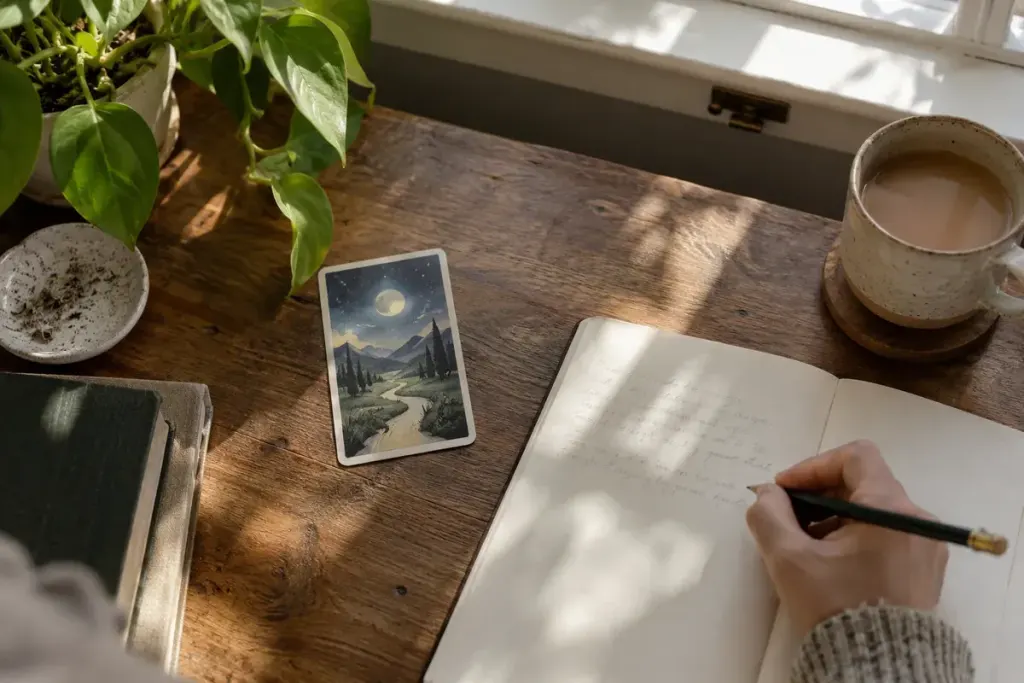
You turn over a card, reach for the guidebook and immediately try to make its description fit your day. There is another way to begin: leave the book closed for a moment and describe the picture in front of you.
This exercise treats tarot as a prompt for reflection. It does not establish what will happen next or reveal another person’s intentions. Its usefulness lies in the questions you choose to explore, and you remain free to set the card aside.
Give the image a minute of ordinary attention
Write down three visible details without interpreting them. “A path curves behind a hill” is an observation. “I am about to face a major obstacle” is an interpretation. Keeping those sentences separate makes it easier to notice when your own concerns enter the reading.
Look for placement, colour, direction and relationships between figures or objects. There is no need to identify every symbol correctly. If something is unclear, describe the uncertainty rather than filling it with a meaning you think you ought to know.
Add your association in a different column
Next to each detail, write what it brings to mind for you. A doorway might suggest welcome, hesitation or an unfinished task. Someone else could see the same doorway differently. These associations are personal material for your journal, not evidence that the image carries one message intended for you.
The V&A’s history of tarot cards places the cards within changing visual and cultural traditions, including their use as a game before later associations with divination. That history is a useful reminder to be curious about an image rather than assuming every detail has one timeless explanation.
Turn an association into a manageable question
Suppose the winding path makes you think of a decision you have postponed. Instead of asking the card to choose for you, try: “What information would help me take the next step?” You can answer that question through ordinary action—finding a date, comparing options or talking to someone involved.
Keep the question within your own experience. “What do I need to ask directly?” is more grounded than “What is this person secretly planning?” A picture cannot verify somebody else’s private thoughts, and a journal should not become a substitute for conversation.
Read the guidebook after your first notes
Now compare the author’s explanation with what you recorded. Mark which ideas belong to the book and which are yours. You may find a connection, a disagreement or nothing useful at all. All three are acceptable outcomes; there is no requirement to force a meaningful reading.
Finish with one sentence about what you will revisit. For example: “I will return to this question after I have gathered the missing information.” Date the entry and leave space for a later note. That helps you distinguish your original impression from the story you might tell after events unfold.
A useful page can be as small as four lines: what I saw, what it reminded me of, what I want to ask and what I can actually do. Use it as a reflective writing practice, while keeping health, financial and other consequential decisions grounded in appropriate evidence and advice.