
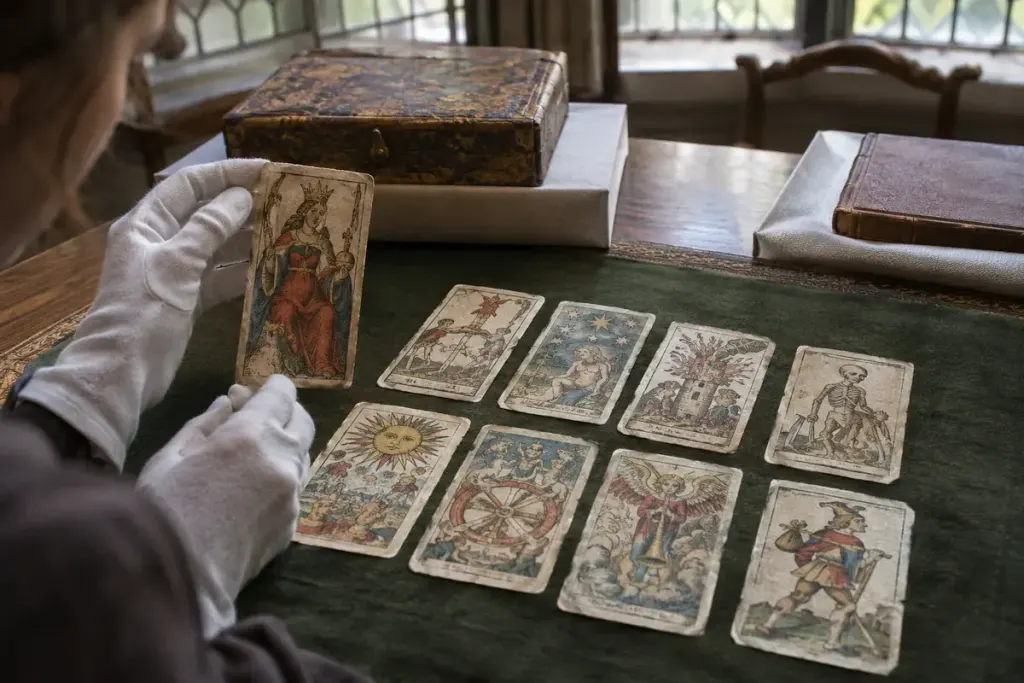
A historical tarot deck is easy to reduce to its most dramatic picture. Jacques Viéville’s deck offers another route: begin with the small physical and printed details that identify the object.
The Bibliothèque nationale de France catalogue record places the Paris publication around 1650. It notes square corners, patterned backs with hexagons and Maltese crosses, and a signature and address on the Two of Coins. These details are useful because they give a viewer something specific to look for rather than a ready-made story about what every card must mean.
Read the object in layers
First separate the catalogue’s description from your own observation. “The record describes a patterned back” is an attributed fact. “The repeated shapes make this reproduction feel orderly to me” is a personal response. Both can belong in a notebook, but they should not be merged into a claim about the maker’s intention.
Next, compare the image and the lettering. The BnF record describes symbolic wording across two cards. Before treating a transcription as a modern reading instruction, remember that spelling, print history and context can complicate interpretation. A catalogue is a starting point for research, not a certificate that one divinatory explanation is historically correct.
Finally, note which version you are actually viewing. A modern restoration or reproduction can change colour, redraw a line or regularise a letter. Write down the edition or digital collection alongside the card name. That makes later comparisons much more meaningful.
A small study that does not need a prediction
Choose one card and make two columns: visible details and questions. In the first, list three features you can point to. In the second, ask what you would need to know to interpret them more confidently. You might need a clearer scan, a translation or a comparison with another card from the same deck.
The exercise can end there. Historical tarot is rewarding as visual culture as well as a reflective practice. Looking carefully at an address, a border or a card back can teach you more about the surviving object than assigning an elaborate meaning to an indistinct symbol.