
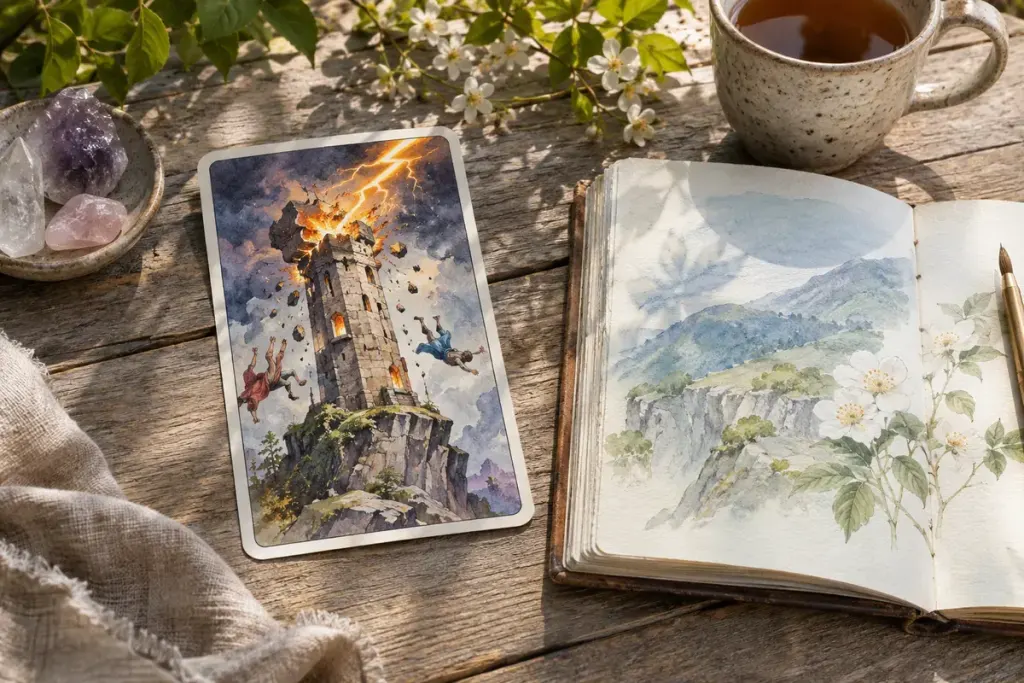
The Tower can interrupt a quiet tarot study session with an image that feels unusually dramatic. Before reaching for a fixed interpretation, slow down and describe the picture in front of you. What has broken? Where are the figures? Which parts of the scene remain standing?
Use the actual deck and edition you own. In the Waite–Smith image, a struck tower, displaced crown and falling figures make disruption visually explicit. Other traditions and modern decks can change those details. An observation about one illustration should not become a claim that every Tower card shows the same event.
Keep observation beside interpretation
Divide a notebook page into two columns. On the first, record visible features in ordinary language: a high building, an opening, a flash, a tilted figure. On the second, record the associations those features bring to mind. “A crown has moved” is an observation; “an authority is being questioned” is an interpretation.
A. E. Waite’s The Pictorial Key to the Tarot is a historical primary text for his own interpretive system. Its discussion of The Tower considers intellectual and doctrinal disruption. Read that as an author’s interpretation from a particular context, not evidence that a drawn card predicts an event.
Now look for something you initially missed. The direction of a figure’s movement, the scale of the tower against the landscape, or an empty patch around the structure may change the emotional emphasis. A small detail can make your reading more specific than a single alarming keyword.
Turn the image into a bounded question
For reflection, try a prompt such as: “Which assumption would I want to examine before relying on it?” Write down a real, manageable example and one way to check it. The card supplies a creative starting point; the evidence and decision still come from ordinary life.
For fiction, imagine the scene immediately before the picture and the first practical action afterwards. This lets the image generate a story without making a claim about your future.
If the illustration feels distressing, put it aside. There is no obligation to continue a reading or search for a frightening explanation. Careful tarot study can stay with art, history and reflection while leaving health, safety and financial decisions to appropriate information and support.