
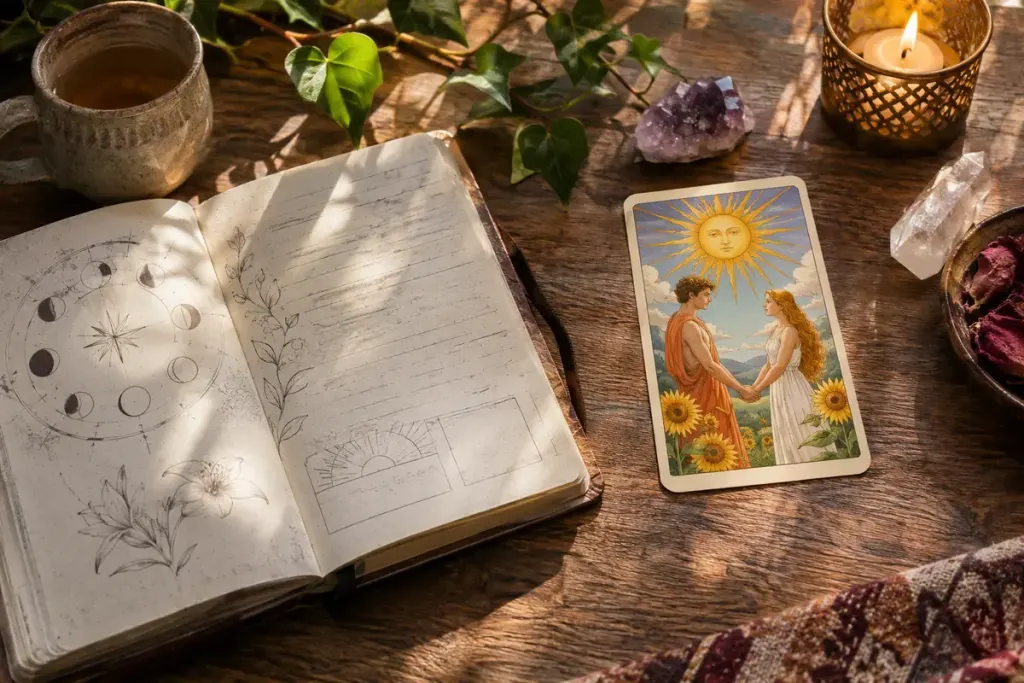
The Lovers is easy to narrow to one question: “Will this relationship work?” Its imagery can support a more interesting conversation about connection, choice and what a person is willing to commit to. Used as a reflective prompt, the card can help organise thoughts without claiming to reveal another person’s mind.
Start with the actual card in your deck. Count the figures, notice their gaze and look for any distance, barrier or shared direction between them. Record what is visibly present before opening the guidebook. A different artist may frame the subject quite differently.
Let the picture come before the keyword
The V&A’s history of tarot documents changing designs and pictorial themes across decks. That history is a good reason to avoid assuming that every card bearing the same title presents an identical scene or a single timeless interpretation.
For another perspective on the theme, the Metropolitan Museum’s account of Nancy Spero’s Lovers discusses a work inspired by the tarot card through ideas of contact and harmony. This is an artistic connection, not evidence that a card predicts events.
In a study journal, make two columns: “what I can see” and “what it brings to mind.” A pair of facing figures belongs in the first if the image shows it. Mutual trust belongs in the second because it is your interpretation. Keeping the columns separate makes your reading more thoughtful.
A values exercise for an ordinary decision
Choose a decision that is yours to make, such as whether to accept an additional commitment. Write down the available options without drawing another card. Under each, note one value it supports, one cost it introduces and one fact you still need to establish.
Then return to the image and ask: Which part of this decision requires alignment between what I say matters and what I actually do? The answer comes from examining your circumstances. The card supplies a starting point, not an instruction.
If the question concerns another person, replace speculation with a conversation you can genuinely have. “What expectations should we discuss?” is more useful than declaring what someone secretly intends.
Close the exercise with one grounded action: clarify a date, ask a question or allow yourself more time. You can keep the symbolic reading open while making the next practical step precise. That balance preserves the imaginative pleasure of tarot without handing responsibility for a decision to an image.