
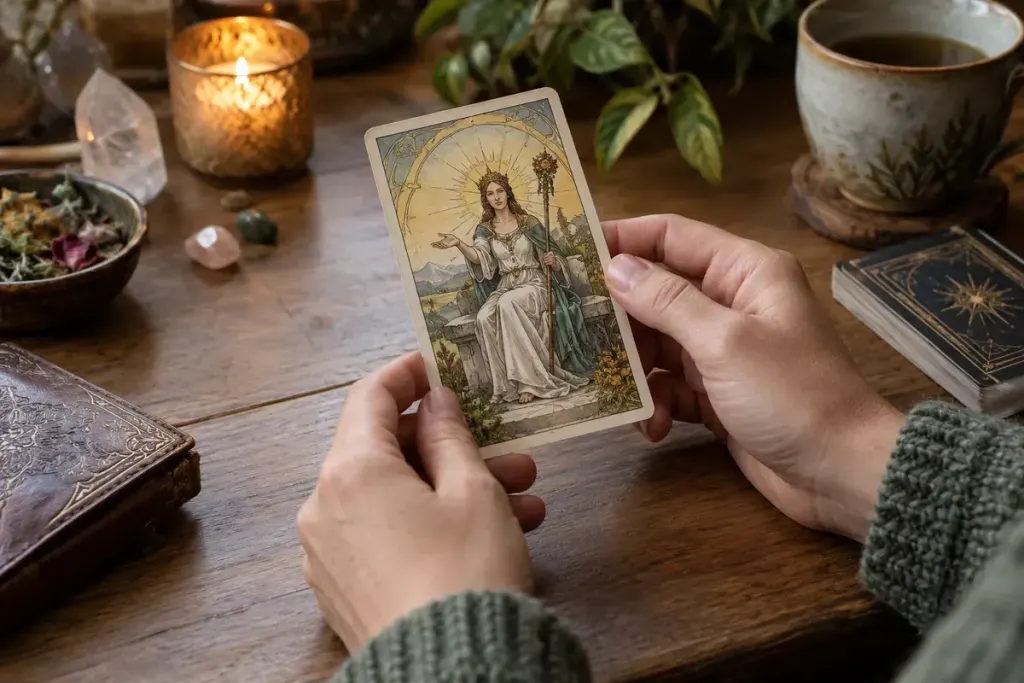
A figure holds one hand open while the other rests close to the body. Before consulting a card meaning, describe the gesture. Is the hand offering, receiving, stopping or simply resting? The image may support several readings, and noticing that uncertainty is part of the exercise.
Begin with what is visible
Choose one card from a deck you own. Write three observations about posture, hands and gaze. Keep them literal at first: “palm turned upward,” “head facing away,” “elbow close to the chair.” Then write possible interpretations in a separate column.
This separation prevents an early association from quietly becoming a fact about the artwork. A raised hand does not have one universal meaning across cultures, periods and artists. The deck’s guidebook may explain a specific choice, or it may leave that detail unaddressed.
Change one imagined detail
Without altering or reproducing the card, imagine the same figure with the hand closed or the gaze turned towards another object. How would your reading change? This is a creative comparison, not a claim about the artist’s original intention.
You could turn the observation into a writing prompt: a fictional character wants to welcome someone but keeps looking towards the door. What tension might that create in a scene? Keep the exercise clearly fictional rather than using the image to infer what a real person secretly thinks.
Compare the gesture with another card in the same deck. Does the surrounding scene alter its effect? A similar hand position beside a cup, a weapon or an empty space may invite different associations.
When you read the guidebook afterwards, note where it confirms, expands or contradicts your initial impression. Record the deck and edition so you can return to the same artwork later.
The result is a more attentive visual journal. It need not produce a prediction, a diagnosis or a decision about someone else’s life. Sometimes the useful discovery is simply that a small gesture you had overlooked gives the picture more than one possible story.