
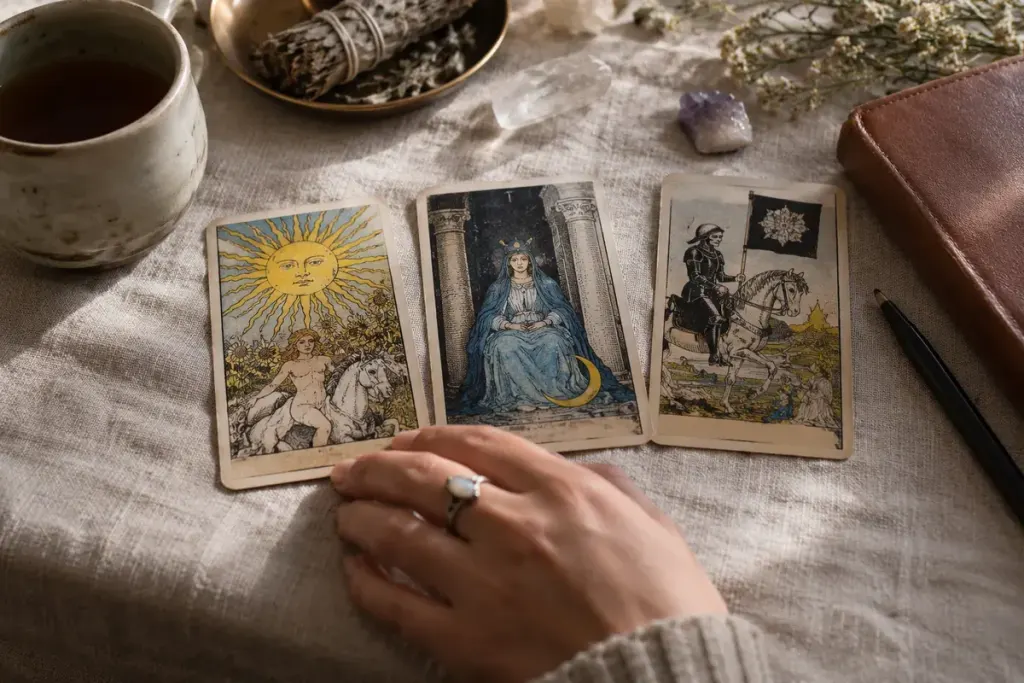
Three cards can be read as three separate pictures. They can also form a small visual scene: one figure looks away, another points toward the centre, and an empty space becomes noticeable between them. Studying those relationships is a creative exercise, not evidence about what another person thinks or what will happen next.
Describe the arrangement before interpreting it
Lay out a small group of cards and write only what is visible. Note the direction of faces and movement, repeated colours, open and closed spaces, and objects that appear to connect across the edges. Keep familiar card meanings out of this first pass.
For example, two figures facing away from each other might suggest distance in a fictional scene. That observation does not establish conflict in your life. Try a second description: perhaps each figure is attending to a different task. The alternative prevents the first story from becoming an unquestioned verdict.
Change the order, then compare your response
Swap the outer cards and describe what changes. Does an apparent departure become an arrival? Does the centre feel more crowded? You are testing how composition influences your response, not improving the accuracy of a prediction.
Use three columns in a journal:
- Observation: the figure faces the edge of the arrangement.
- Possible association: leaving, searching or looking beyond the scene.
- Reflection question: what am I overlooking outside my current plan?
Leave room for “nothing useful came to mind.” A reflection exercise does not need to produce a message every time. If a card arrangement feels upsetting, stop or choose a neutral creative task such as inventing a scene for a fictional character.
Different decks use different visual systems, so compare the actual artwork rather than assuming every card must behave the same way. Keep decisions about health, money and relationships grounded in evidence and appropriate advice. The value here is in noticing your own associations while retaining the freedom to question them.