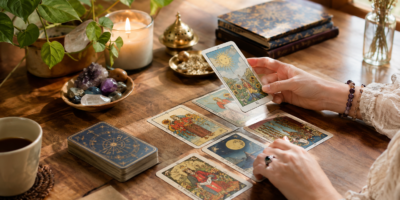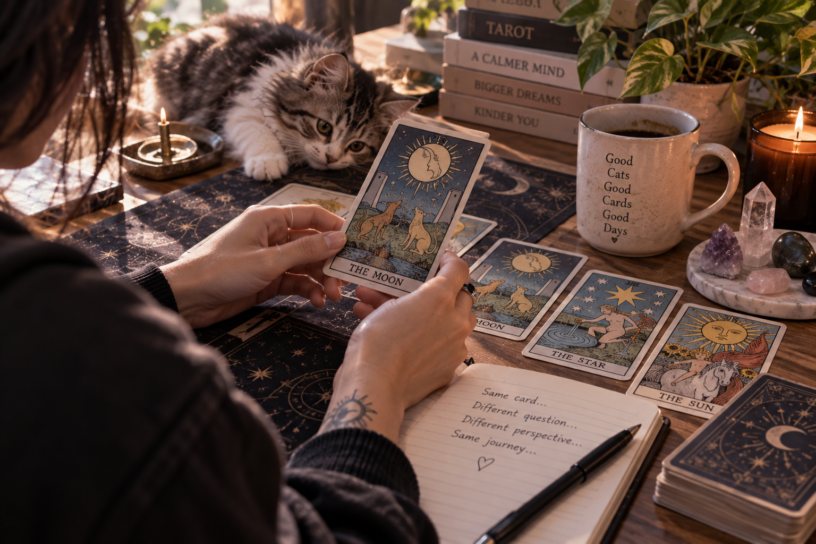



You shuffle the deck, ask a question, and pull a card.
A few days later, you do another reading.
There it is again.
The same card.
Maybe it is The Hermit. The Tower. The Star. The Lovers. Or perhaps one of the Minor Arcana that seems determined to keep appearing.
When this happens, it is tempting to assume that the card must be repeating exactly the same message.
But repeating tarot cards do not necessarily need to be interpreted identically every time they appear.
A tarot card carries established symbols, themes, and associations, but a reading also depends on the question being explored, the position of the card, the surrounding cards, and the context you bring to the reading.
The card may be the same.
The conversation around it may be completely different.
A Tarot Card Is More Than One Definition
One of the first habits beginners often develop is memorizing keywords.
The Fool means beginnings.
The Hermit means introspection.
The Lovers means relationships or choices.
Death means transformation.
The Tower means disruption.
These associations can be useful when learning tarot.
But they are starting points rather than complete readings.
If every card had exactly one fixed sentence attached to it, tarot would require little interpretation. You could simply look up the definition and finish.
The richness comes from how a card’s themes interact with context.
Think of Tarot Like a Language
A word can have a general definition while changing meaning depending on the sentence.
Consider the word “light.”
It could describe illumination.
It could describe something that is not heavy.
It could refer to a pale color.
It could appear metaphorically when someone says they finally “see the light.”
The word did not become meaningless simply because it can function differently.
Context clarified which part of its meaning mattered.
Tarot cards can work similarly.
A card maintains its symbolic identity while different aspects of that symbolism become relevant in different readings.
The Question Changes the Reading
Imagine pulling The Hermit while asking:
“What should I focus on in my career?”
The card might encourage reflection, independent thinking, deeper study, or stepping away from external pressure long enough to determine your own direction.
Now imagine The Hermit appearing when asking:
“What pattern is affecting my friendships?”
Suddenly, isolation, emotional distance, boundaries, or a need for personal space might become more relevant.
The imagery did not change.
The question did.
That is why reading a card without remembering what you asked can produce vague interpretations.
Position Matters in a Tarot Spread
Many tarot spreads assign specific roles to different card positions.
Past.
Present.
Future.
Challenge.
Advice.
External influence.
Internal influence.
What to release.
What to develop.
A card appearing as a challenge should not automatically be read exactly as it would appear in an advice position.
Suppose Strength appears under “what helps you.”
Its themes might point toward patience, courage, or calm self-control.
If Strength appears under “what is blocking you,” you might explore whether you are trying too hard to control a situation or placing unrealistic pressure on yourself to remain composed.
Same card.
Different function.
The Cards Around It Create Context
A tarot card rarely exists alone in a multi-card spread.
Neighboring cards can change which themes deserve attention.
Consider The Hermit beside The High Priestess.
The combination may emphasize inward reflection, intuition, silence, or private understanding.
Now place The Hermit beside Three of Cups.
The contrast between solitude and community becomes more noticeable.
Neither combination automatically has one universally correct interpretation.
But the surrounding cards create relationships between symbols.
Reading those relationships is an important part of moving beyond isolated card definitions.
Repeating Cards Naturally Get Your Attention
Seeing the same card several times can feel significant.
At minimum, repetition catches attention.
That makes it useful as a prompt for reflection.
Instead of immediately asking, “What prediction is this card making?” consider asking:
Why does this card stand out to me right now?
Which part of its imagery keeps attracting my attention?
Has my interpretation changed since the previous reading?
Am I asking variations of the same question?
Is there a theme here that I keep returning to?
Those questions turn repetition into an opportunity for deeper observation.
But Repetition Does Not Automatically Prove a Prediction
This distinction matters.
Tarot can be used as a reflective or spiritual practice without treating every repeated card as guaranteed evidence that a particular external event will happen.
Cards are physically drawn from a finite deck.
Repeats can occur.
What makes the experience interesting is what you do with the repetition.
If The Tower appears three times, you do not necessarily need to conclude that a disaster is approaching.
You might instead explore your relationship with instability, unexpected change, fragile assumptions, or structures in your life that no longer feel sustainable.
Reflection leaves room for interpretation without turning uncertainty into certainty.
Your First Reaction Can Be Useful Information
Before opening a guidebook, notice your immediate response to the card.
Relief?
Annoyance?
Fear?
Recognition?
Confusion?
Excitement?
Suppose you pull Eight of Cups and instantly think:
“Not this again.”
That reaction itself is interesting.
Why are you frustrated by the card?
Does its theme touch something you do not want to consider?
Are you tired of interpreting it the same way?
Your emotional response should not automatically determine the card’s meaning, but it can reveal something about your relationship with the topic.
Look at the Image Before the Keywords
Tarot becomes mechanical when every reading begins and ends with memorized definitions.
Try spending a moment with the artwork first.
What is happening in the scene?
Where does your eye go?
What expression does the figure have?
Which object seems important?
Is the image active or still?
Open or confined?
Bright or dark?
What appears to be happening immediately before or after the moment illustrated?
Different decks can emphasize different visual details.
That is one reason the same card can feel surprisingly different across tarot decks.
Different Decks Can Emphasize Different Themes
A traditional Rider-Waite-Smith-inspired deck may present familiar symbolism.
A modern deck might reinterpret the scene.
An animal deck may replace human figures with creatures.
An abstract deck may rely heavily on color and geometry.
The fundamental card structure may remain recognizable, but the artwork influences the reader’s attention.
For example, one depiction of The Star might emphasize vulnerability.
Another might emphasize hope.
Another may make renewal or connection with nature visually dominant.
The card remains The Star, but the artistic language can shift the reading.
Major Arcana Repetition Can Feel Especially Noticeable
The Major Arcana contains archetypal themes that often feel larger than ordinary daily activities.
Cards such as The Fool, The Magician, The Empress, The Hermit, Death, The Tower, The Star, and The World naturally attract attention.
When one repeatedly appears, people often assume the message must be extremely important.
Instead of immediately increasing the drama, increase the curiosity.
What theme does this card traditionally represent?
How has that theme appeared in your questions recently?
Are you repeatedly asking about an area of life connected with it?
A recurring Major Arcana card can become a useful theme for journaling without requiring an extreme interpretation.
Minor Arcana Repetition Can Be Just as Interesting
Beginners sometimes focus so heavily on Major Arcana cards that they overlook repeating Minor Arcana.
But Minor Arcana can provide rich reflective material.
Repeated Cups may draw attention toward emotional experiences and relationships.
Swords can invite examination of thoughts, communication, tension, or decision-making.
Pentacles may direct attention toward practical matters, resources, routines, work, or stability.
Wands can emphasize action, creativity, ambition, energy, and initiative.
Again, these are broad associations rather than rigid formulas.
The specific card and reading context still matter.
Repeating Numbers Can Create Another Layer
Sometimes the exact card does not repeat, but a number does.
Two of Cups.
Two of Swords.
Two of Pentacles.
Several twos appearing across readings may encourage you to explore themes associated with choice, balance, duality, partnership, or competing directions.
Likewise, multiple fives might lead you to notice tension or transition.
Repeated tens could bring attention toward completion, culmination, or what happens at the end of a cycle.
Numerology can provide another interpretive layer, but it should support the reading rather than overpower the actual cards.
Court Cards Can Be Read in Several Ways
Pages, Knights, Queens, and Kings often confuse new readers because they can be approached from multiple directions.
A court card might represent:
A person.
A personality style.
A role you are taking.
A quality you need to develop.
A pattern in how you approach a situation.
Imagine the Queen of Swords appearing repeatedly.
Instead of immediately deciding that it represents one specific woman, you could explore themes such as clear communication, discernment, boundaries, independence, or intellectual honesty.
Which interpretation fits depends on the question and context.
Reversals Add Another Dimension—If You Use Them
Some tarot readers interpret reversed cards.
Others do not.
Neither approach is required for meaningful practice.
When reversals are used, a reversed card does not always need to mean the exact opposite of its upright interpretation.
It might suggest:
An internalized version of the theme.
A blocked expression.
An imbalance.
An excess.
A delay.
Something being reconsidered.
The interpretation depends on the reader’s system.
Consistency matters more than inventing a completely different rule every time a reversal appears.
You Do Not Need to Force a Dramatic Meaning
One of the easiest ways to lose clarity in tarot is assuming every card must reveal something extraordinary.
Sometimes Four of Swords can simply encourage rest.
Sometimes Two of Pentacles reflects an overloaded schedule.
Sometimes Eight of Pentacles can draw attention toward practice and gradual improvement.
Not every reading needs to uncover a hidden destiny.
Tarot can be valuable when it helps you notice ordinary patterns you have been ignoring.
In fact, those ordinary patterns may be more actionable than dramatic predictions.
Ask Better Questions When a Card Repeats
When repeating tarot cards appear, asking another yes-or-no question about the same situation can create more confusion.
Instead, change the question.
Rather than:
“Is this card telling me to leave?”
Try:
“What part of this situation deserves more attention?”
“What am I overlooking?”
“What assumption am I bringing into this decision?”
“What would help me approach this more clearly?”
“What can I control here?”
Questions that encourage exploration usually provide more room for useful interpretation.
Be Careful About Asking the Same Question Repeatedly
Imagine asking a question, receiving a reading you dislike, shuffling again, and repeating the question.
Then doing it again.
Eventually, you may have several contradictory spreads.
This often creates less clarity rather than more.
Repeatedly drawing cards until you receive a preferred answer can turn tarot into a search for reassurance.
If a reading leaves you uncertain, consider writing it down and stepping away.
Returning later with a calmer perspective can sometimes be more useful than immediately drawing more cards.
Tarot Journaling Makes Repetition Easier to Understand
Memory is unreliable.
You may feel like a card “always” appears when it has actually shown up three times across several months.
A tarot journal provides context.
Record the date.
Write down your question.
Note the cards and their positions.
Add your initial interpretation.
You can also record what stood out visually and how you felt about the reading.
When a card repeats later, compare the entries.
This allows you to see whether the surrounding circumstances are genuinely similar.
Your Interpretation Can Change Over Time
Suppose The Chariot appeared six months ago during a period when you were aggressively pursuing a goal.
You interpreted it as determination and forward movement.
Months later, it appears again when you are exhausted from trying to control too many things.
Now another aspect may become relevant: direction, discipline, competing forces, or the question of whether effort is actually aligned.
The card did not betray its original meaning.
Your circumstances changed.
That is part of why keeping old readings can be interesting.
You get to see how your relationship with the symbolism develops.
Personal Associations Matter, but They Need Structure
Perhaps cats appear prominently in the artwork of your favorite deck.
Maybe a particular flower reminds you of someone.
A certain color could carry a strong personal association.
These details can contribute to a reading.
But personal intuition does not require abandoning the traditional structure of tarot.
A useful approach is to hold both.
What does the card traditionally represent?
What does this particular artwork emphasize?
What does the symbol mean personally to you?
How does that connect with the question?
The intersection of those layers often creates richer interpretation.
Intuition Does Not Have to Mean Guessing
People sometimes imagine intuitive tarot reading as looking at a card and spontaneously receiving a perfect answer.
That expectation can make beginners doubt themselves.
Intuition can be much quieter.
It might be noticing one detail before all the others.
Recognizing an emotional reaction.
Connecting two cards that initially seemed unrelated.
Remembering something relevant while looking at an image.
The skill develops partly through familiarity.
The better you understand the deck’s structure and symbolism, the more material your intuition has to work with.
Guidebooks Are Tools, Not Tests
There is nothing wrong with checking a guidebook.
Experienced readers still use reference material.
The goal is not to prove that you have memorized seventy-eight perfect definitions.
Use the guidebook to expand your understanding.
Then return to the card.
Which interpretation actually fits the question?
Which symbols are present in this deck?
How does the card interact with the rest of the spread?
Reading tarot is not an exam where consulting a book means you failed.
Avoid Letting One Difficult Card Control the Entire Spread
Cards such as Death, The Devil, Ten of Swords, Three of Swords, or The Tower can immediately dominate attention.
A reader sees one and forgets everything else.
Pause.
Look at the entire spread.
What position does the card occupy?
What comes before it?
What follows it?
Are supportive cards present?
Is the reading actually about an external event, or could the difficult imagery be describing an internal pattern, fear, transition, attachment, or belief?
A dramatic image deserves attention.
It does not automatically deserve control over every other card.
Positive Cards Also Need Context
The same principle applies to cards people enjoy seeing.
The Sun does not require every situation to become perfect.
Ten of Cups does not guarantee an ideal relationship.
The Star does not promise that every desired outcome will happen exactly as imagined.
Positive cards can explore optimism, openness, emotional connection, hope, clarity, or renewal without becoming guarantees.
Balanced tarot interpretation avoids turning either difficult or encouraging cards into absolute predictions.
Sometimes the Reading Is About the Questioner
A common temptation is using tarot primarily to determine what someone else thinks.
“What does this person feel?”
“What are they hiding?”
“What will they do?”
The problem is that these questions can encourage certainty about another person’s private thoughts without direct evidence.
A more grounded approach brings the reading back toward your own choices.
“How am I responding to this relationship?”
“What boundary needs attention?”
“What information do I actually have?”
“What would help me communicate clearly?”
“What do I need regardless of what the other person chooses?”
These questions preserve your agency.
Tarot Should Not Replace Important Real-World Information
Tarot can provide a framework for reflection.
It should not be treated as a substitute for evidence when decisions carry serious consequences.
Medical concerns need qualified medical advice.
Legal problems need appropriate legal guidance.
Major financial decisions require real financial information.
Safety concerns should be handled through practical action.
A tarot reading can help someone explore feelings about a decision, but the cards do not replace the information required to make that decision responsibly.
A Repeating Card Can Become a Reflection Prompt
Suppose The Hermit keeps appearing.
Instead of trying to determine exactly what future event it predicts, spend time with its themes.
Where do I need quiet?
Am I relying too heavily on other people’s opinions?
Have I isolated myself more than I intended?
What am I trying to understand?
Would stepping away from noise help me think more clearly?
Notice how one card can generate several different questions.
That is more useful than forcing it into one sentence.
You Can Also Take a Break From the Card
Sometimes repeated readings become mentally exhausting.
You pull the same card.
Think about it all day.
Read several interpretations online.
Ask another question.
Pull more cards.
Eventually, the practice creates anxiety rather than reflection.
You are allowed to stop.
Put the deck away.
Do something unrelated.
Return when you actually have enough distance to approach the question differently.
More cards do not automatically create more clarity.
The Goal Is Not to Find the “Perfect” Interpretation
Tarot reading involves interpretation.
Two thoughtful readers can look at the same spread and emphasize different details without either interpretation being meaningless.
The goal is not always to discover one secret sentence hidden inside the cards.
A better question is whether the interpretation is coherent, relevant to the question, consistent with the symbolism, and useful for reflection.
That approach gives tarot structure without pretending uncertainty has disappeared.
Conclusion
Seeing repeating tarot cards can be fascinating because repetition naturally draws attention.
But the same card does not have to communicate an identical message every time it appears.
Its traditional symbolism remains important, while the question, spread position, surrounding cards, deck artwork, personal associations, and current circumstances help determine which part of that symbolism deserves attention.
Instead of immediately treating a repeated card as a fixed prediction, become curious about it.
Record the reading.
Compare it with previous appearances.
Notice what has changed.
Ask what theme continues to feel relevant.
Tarot becomes more interesting when cards are treated not as rigid answers, but as symbols capable of opening better questions.