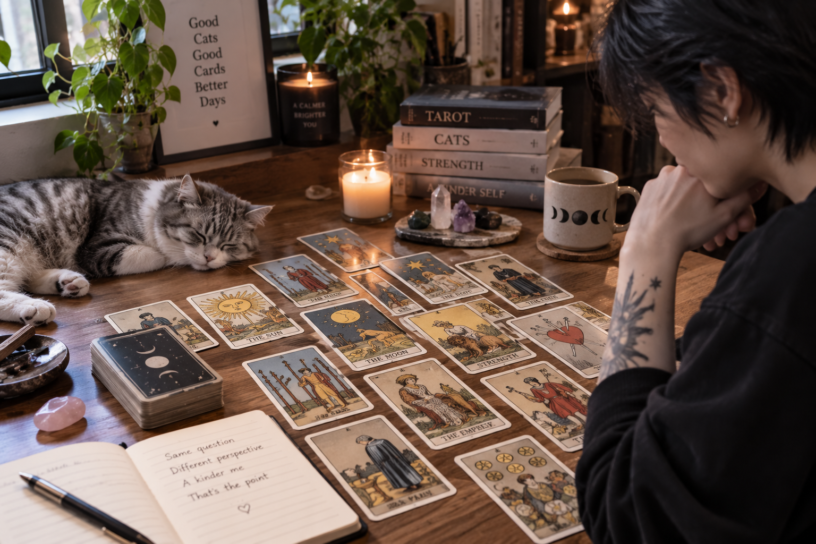

It begins with a simple question.
You shuffle the deck, pull a card, turn it over, and stare at the image. The message feels interesting, but not quite specific enough.
So you pull another card for clarification.
The second card seems to introduce a completely different idea. Naturally, you need to understand how the two connect, so you pull a third. Then you ask what you should do about the situation. Another card. Then one for what happens next.
Before long, half the table is covered.
If you’ve ever ended a reading more confused than when you started, the problem may not be that you are “bad” at tarot. Sometimes too many tarot cards simply create more information than the original question needs.
More Cards Do Not Automatically Create More Clarity
It is easy to assume that uncertainty can be solved by gathering more information.
Sometimes it can.
But tarot readings can reach a point where each additional card creates another interpretation rather than resolving the previous one.
One card might suggest patience.
The next emphasizes action.
Another brings attention to an emotional pattern.
A fourth seems focused on practical concerns.
None of those themes necessarily contradict one another, but now you have to decide how they relate.
The reading becomes an interpretation problem created by the attempt to eliminate uncertainty.
Start by Asking Whether the First Card Was Actually Unclear
There is a difference between not understanding a card and not liking what it seems to suggest.
That distinction matters.
Sometimes the first card is genuinely difficult to interpret in relation to the question.
A clarifier may be useful.
At other times, the card makes reasonable sense, but the answer feels uncomfortable, incomplete, or different from what we hoped to see.
Pulling another card can then become a way of asking the deck to give us a different answer.
That usually creates noise rather than insight.
Clarifier Cards Work Best When They Have a Job
A clarifier does not have to mean simply “tell me more.”
Give it a specific purpose.
Suppose your original card suggests hesitation.
Instead of pulling another card and asking vaguely for clarification, you might ask what is contributing to that hesitation.
Now the second card has a defined role.
The relationship between the cards becomes easier to interpret because each one answers a different part of the same question.
Without that structure, clarifiers can quickly become additional readings disguised as clarification.
Repeating the Same Question Changes the Experience
Imagine asking:
“Should I take this opportunity?”
You pull a card.
Then you reshuffle and ask again.
And again.
Eventually, you may receive enough different imagery to support almost any interpretation you want.
At that point, the reading is no longer helping you explore the question.
You are searching through possibilities until one feels satisfying.
For reflective tarot practice, that can be a useful moment to stop and ask why a particular answer feels so important.
The reaction may tell you more than another card will.
Tarot Cannot Remove Every Uncertainty
Some decisions genuinely contain uncertainty.
You may not know how another person will respond.
You may not know whether a new job will work out.
You may not know how you will feel six months from now.
It can be tempting to keep pulling cards until the uncertainty disappears.
But no number of cards can transform every uncertain situation into guaranteed knowledge.
Tarot can instead be used to explore your expectations, fears, assumptions, priorities, and possible approaches to the situation.
That is a different purpose—and often a more useful one.
A Small Spread Creates Useful Boundaries
A defined spread gives each card a position and purpose.
For example, three cards could represent the current situation, what deserves attention, and a possible next step.
The exact structure can change depending on your practice.
What matters is that the reading has boundaries before you begin.
Without boundaries, every card can generate another question.
With them, you know when the reading is complete.
That makes interpretation more focused and reduces the temptation to keep expanding the spread whenever something feels ambiguous.
One-Card Readings Can Be Surprisingly Deep
A single card may look too simple, especially when you own a full deck filled with rich imagery.
But limitation can create depth.
Instead of immediately moving to another card, stay with the first one.
What catches your attention first?
Which symbol feels relevant?
What emotion does the card create?
How does its traditional meaning interact with the actual question?
What part of the card feels difficult to accept?
Spending ten minutes with one card can sometimes reveal more than spending ten seconds each on ten cards.
Look at the Image Before Reaching for a Guidebook
Guidebooks are useful.
But immediately searching for a fixed meaning can sometimes bypass your own observation.
Before reading an interpretation, notice what is actually happening in the image.
Where does your eye go?
Does the scene feel open or restrictive?
Is the figure moving or stationary?
What seems absent?
What detail makes you uncomfortable or curious?
This does not mean traditional card meanings should be ignored.
It simply allows personal observation and established symbolism to participate in the same reading.
Write the Question Down Before You Shuffle
A surprisingly effective way to prevent a reading from expanding uncontrollably is to write down the original question.
Once several cards are on the table, it is easy for the reading to drift.
You start by asking about work.
Then one card reminds you of a relationship.
Another makes you think about money.
Soon you are trying to interpret three areas of life at once.
Returning to the written question creates an anchor.
Does this interpretation actually address what you asked?
If not, you may be following an interesting association rather than the original reading.
Vague Questions Naturally Produce Broad Readings
“What is going on with my life?”
That is an enormous question.
Almost any tarot card could connect to it somehow.
A more focused question gives the reading something to work around.
Instead of asking what is happening with your entire life, you might explore what deserves your attention in your current work situation or what internal pattern is influencing a particular decision.
Specific does not have to mean predictive.
It simply means giving the reflection a clear boundary.
The Desire for Certainty Can Hide Inside “One More Card”
Sometimes the issue is not interpretation at all.
It is anxiety.
You want reassurance that the decision will work.
You want confirmation that someone feels the way you hope.
You want certainty that you are making the correct choice.
So you pull another card.
Then another.
Recognizing this pattern does not invalidate tarot practice. It can actually deepen it.
Instead of asking for another answer, you can ask yourself why uncertainty feels so difficult to tolerate in that moment.
Contradictory Cards May Not Actually Contradict Each Other
Suppose one card appears to emphasize rest while another suggests movement.
It is tempting to assume the deck has become inconsistent.
But context matters.
Perhaps one card describes your internal state while the other relates to external action.
Perhaps rest is needed before movement.
Perhaps you are being invited to distinguish impulsive activity from deliberate progress.
Before pulling another clarifier to resolve the “contradiction,” explore whether both ideas can exist simultaneously.
Real situations are often complicated enough to contain opposing needs.
Too Many Clarifiers Can Flatten the Original Card
There is another problem with pulling clarifier after clarifier.
The original card can disappear.
You begin with one strong image containing several possible layers of meaning. Then five additional cards surround it, and attention shifts toward explaining the new cards instead.
Eventually, the first card becomes almost irrelevant.
If that happens regularly, try setting a limit before the reading.
One clarifier may be enough.
After that, return to the original card and reconsider it with the additional context you now have.
Reading Reversals Can Add Complexity
Some readers use reversed cards and some do not.
Neither approach needs to be treated as universally correct.
But if you already struggle with overloaded readings, adding another interpretive system can increase complexity.
You might temporarily work with upright cards while building familiarity with the deck, or use reversals only if they genuinely contribute to your practice.
The goal is not to use every available tarot technique.
It is to create a system you can interpret consistently.
Complexity is useful only when it adds meaning.
Different Decks Can Create Different Associations
Deck artwork matters.
Even when two decks follow a similar traditional structure, their visual language may produce different emotional associations.
That can be valuable.
It can also become confusing if you switch between several decks during one question because you dislike what the first one seemed to communicate.
Instead, consider choosing a deck before beginning and staying with it for that reading.
The boundary helps preserve continuity.
You can always explore the same theme with another deck on a different day.
Journaling Extends a Reading Without Adding More Cards
If you still feel there is more to explore, you do not necessarily need another draw.
Write about the cards already on the table.
Describe your first reaction.
Write down the interpretation you resisted.
Note which symbol keeps attracting your attention.
Consider how the reading relates to your actual circumstances rather than an imagined future.
Journaling slows the process down.
Instead of adding new information, it helps you process the information you already have.
Take a Photo and Come Back Later
Not every reading needs to make perfect sense immediately.
Sometimes distance helps.
Take a photo of the spread if you want to preserve it, write down the question, and return later.
Your interpretation may change once the emotional intensity surrounding the question has decreased.
This is especially useful when the reading concerns something you feel strongly about.
Immediate interpretation can become tangled with what you desperately want—or fear—the cards are saying.
Time creates another perspective without requiring another draw.
Notice Which Card You Keep Thinking About
After a reading, you may forget several cards almost immediately.
One remains in your mind.
That is interesting.
Maybe its image bothered you.
Maybe its message felt unusually relevant.
Maybe you could not understand why it appeared.
Instead of pulling more cards, spend time with the one that stayed.
A reading does not have to be valuable because every card produces a neat conclusion.
Sometimes one lingering image is enough to create useful reflection.
Tarot Can Help You Ask Better Questions
One of the most practical uses of tarot is not necessarily finding answers.
It can expose the question underneath the question.
You begin with:
“Will this work?”
But while reflecting, you realize what you actually want to know is:
“Am I willing to accept the consequences if it doesn’t?”
That second question may be much more useful.
The cards did not need to predict the outcome.
They helped reveal what the decision means to you.
Know When the Reading Is Finished
This sounds obvious, but many confusing readings happen because there is no stopping rule.
Before you begin, decide what completion looks like.
Maybe it is one card.
Maybe it is a three-card spread.
Maybe you allow one clarifier if necessary.
Once those cards are drawn, interpretation begins and card pulling ends.
You can always return to the subject later.
Creating an ending prevents curiosity from turning a focused reading into an endless chain of questions.
If You Are Too Emotionally Activated, Waiting Can Help
There are moments when reflection becomes difficult.
Maybe you have just received upsetting news.
Maybe you are waiting for an important message.
Maybe you are extremely anxious about a decision.
In that state, it can be tempting to repeatedly pull cards for reassurance.
Waiting until you feel more settled may produce a more useful reading.
Tarot can support reflection, but it does not have to become a tool for repeatedly checking whether your fear or hope has changed.
Sometimes the best reading begins after the emotional urgency has softened.
You Are Still the Person Making the Decision
A tarot spread can highlight patterns, create prompts, reveal associations, and help you consider perspectives you had not articulated.
It does not remove your agency.
If you are deciding whether to change jobs, end a relationship, spend money, move somewhere, or make another meaningful life choice, practical information still matters.
Your circumstances matter.
Your values matter.
Consequences matter.
Tarot can sit alongside that process as a reflective practice without becoming the authority that makes the decision for you.
A Clear Reading Does Not Need a Dramatic Answer
Sometimes the useful conclusion is surprisingly ordinary.
You already know what needs attention.
You need more information.
You need to have a conversation.
You are avoiding a decision.
You are exhausted and should revisit the question later.
Not every reading needs to reveal a hidden destiny.
A simple observation that changes how you think about a situation can be enough.
Conclusion
Having too many tarot cards on the table does not necessarily create a deeper reading.
Sometimes it creates more symbols, more possible interpretations, and more opportunities to lose sight of the question that started everything.
Try giving each card a clear purpose. Use smaller spreads, limit clarifiers, write down the original question, and spend more time interpreting before reaching for another card.
If uncertainty remains, consider whether another draw would genuinely add information—or whether you are asking the deck to remove uncertainty that simply belongs to the situation.
Tarot does not always become clearer when you ask it to say more.
Sometimes the most useful thing you can do is look at the cards already in front of you and decide:
That is enough for today.
