
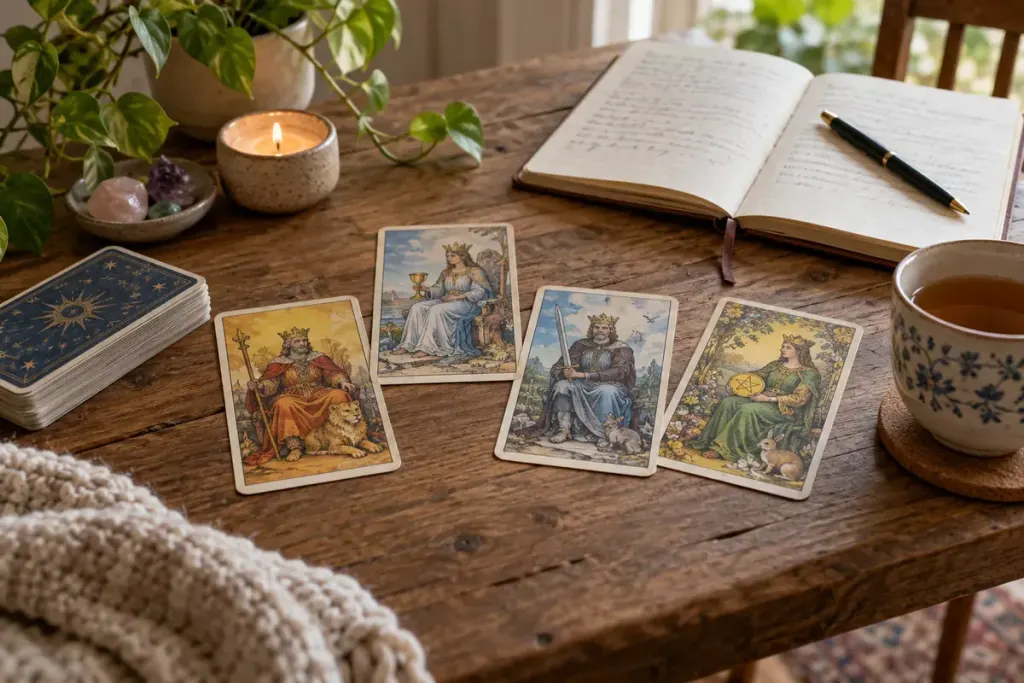
A page and a knight can appear to suggest similar energy: both may feel active, unfinished or in motion. For a reflective reading, it helps to ask what kind of movement you are considering. Are you still learning what matters, or already acting on an idea?
Deck traditions differ, and some replace these court titles entirely. Begin with the imagery and guidebook for the deck in front of you. The exercise below is an interpretive approach, not a universal dictionary of meanings.
Give each card a different question
Try reading the page through curiosity: “What do I need to notice, practise or ask?” Read the knight through directed action: “What am I pursuing, and how am I moving towards it?” Neither role needs to be assigned an age or gender.
Then bring in the suit. A practical task, an emotional conversation and an intellectual disagreement do not require the same response. Describe one detail in the image before reaching for a memorised label.
Turn the contrast into two journal entries
For an invented example about learning to draw, the page entry might identify a skill to practise: observing the angles of a cup. The knight entry might identify a commitment: setting aside a short session tomorrow. The second does not make the first less important.
Write one possible difficulty beside each. Curiosity can become endless preparation; action can become rushing past information. The cards can help frame that tension without proving that either description is true of you.
Finish by choosing an ordinary, reversible next step based on your circumstances. Tarot is not evidence about another person’s intentions or a substitute for medical, legal or financial advice. Its useful role here is to make a familiar question more specific: what needs learning, and what is ready to be tried?