
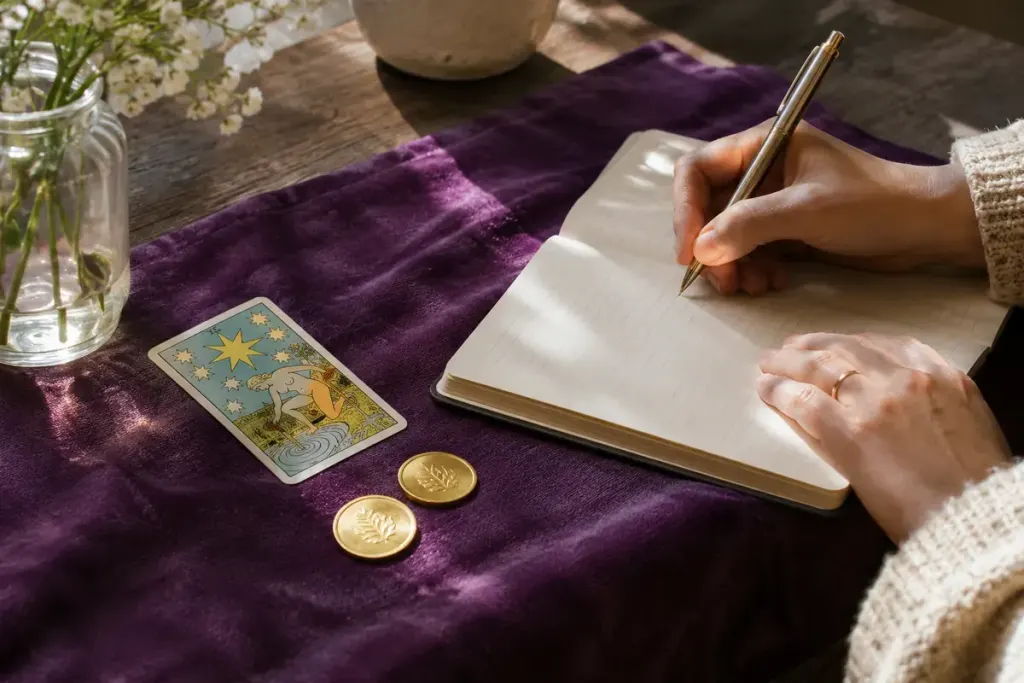
The Two of Pentacles often invites a familiar response: “I have too much to juggle.” That recognition can be useful, but it is only the opening of a reflection. The more interesting question is what, exactly, is moving between your hands.
In a common Rider–Waite–Smith-style image, a figure handles two coins while ships ride waves behind them. Labyrinthos’s interpretation of the card connects it with balance and adapting to competing demands. This is an interpretive tradition, not evidence that the card predicts events or knows your circumstances.
Give the two coins concrete names
For a short journaling exercise, choose two commitments that actually compete for a resource. “Work” and “life” may be too broad. “Finish the application on Thursday evening” and “attend a friend’s celebration on Thursday evening” reveal the conflict more clearly.
Write down the resource each needs: time, attention, money, transport or recovery time afterwards. Then distinguish a fixed constraint from an assumption. The celebration may have a fixed start; the application may be due the following afternoon rather than that night. A schedule can change when its details become visible.
Use three prompts:
- What have I already promised, and to whom?
- What can be adjusted through a real conversation?
- What would I deliberately leave undone rather than pretend to carry indefinitely?
These questions are a suggested reflective exercise, not meanings that every reader must assign to the card. A different deck may depict the suit or the number in a different visual language. Describe what is on your own card before importing an interpretation.
End the page with one practical action, such as checking a deadline or asking to change a meeting. Avoid using a draw to decide someone else’s intentions, predict a financial result or replace professional advice. The value of the exercise lies in the attention you bring to an ordinary choice, with the image serving as a prompt.