
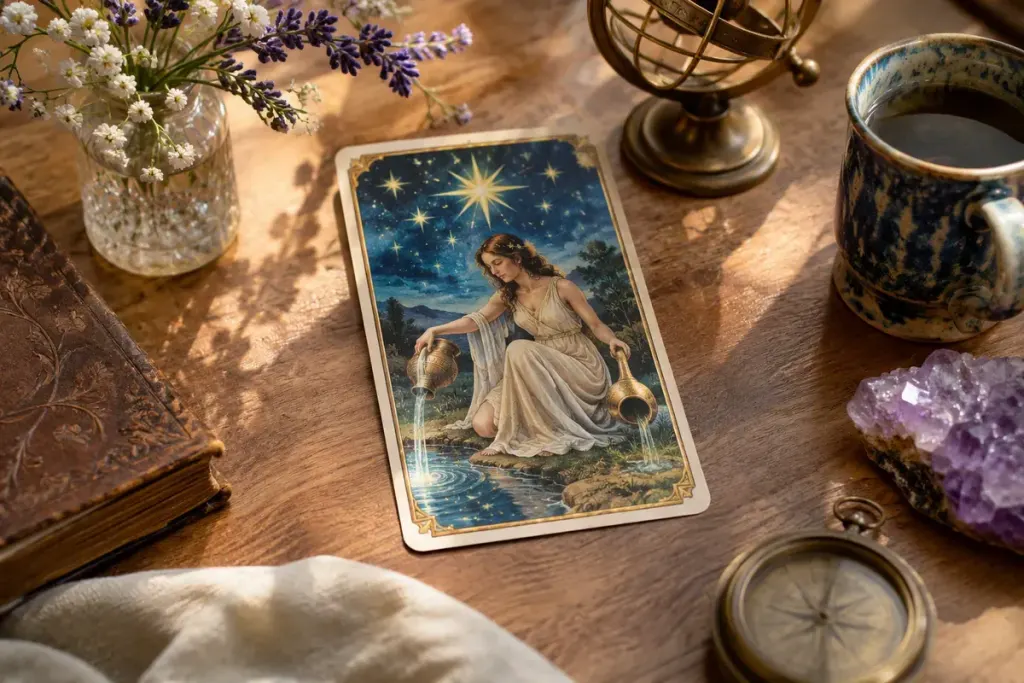
Before attaching a meaning to the Star card, spend a moment with the direction of its water. In the familiar Waite-Smith image, the figure pours from two vessels: one toward the pool and another toward the land.
A. E. Waite’s Pictorial Key to the Tarot describes this imagery. The historical text is a source for studying the deck, not evidence that a card predicts a person’s future. Other decks can redraw the scene or emphasise different symbols.
Make two columns in a notebook
Label the first column “what I can see” and the second “what it brings to mind”. In the first, record concrete details: the vessels, the water, the ground and the figure’s posture. In the second, write your associations without presenting them as facts about the image’s maker.
For example, water reaching two places might prompt a reflection about dividing attention between private restoration and practical responsibilities. That is a possible personal reading, not a fixed instruction hidden in the picture. Someone else may notice continuity, exposure or the landscape instead.
Turn an association into a modest question
Choose one observation and ask something you can answer from ordinary experience: “Which activity has helped me feel restored this week?” is more usable than asking the card to guarantee that everything will improve. Write an answer and one small action you can realistically take.
If you compare decks, note which visual elements remain and which disappear. A changed vessel or landscape may shift your response even when the card retains the same title.
Keep the exercise open-ended. It can support looking, journaling and conversation, while health, financial and other consequential decisions still need evidence appropriate to those decisions.