
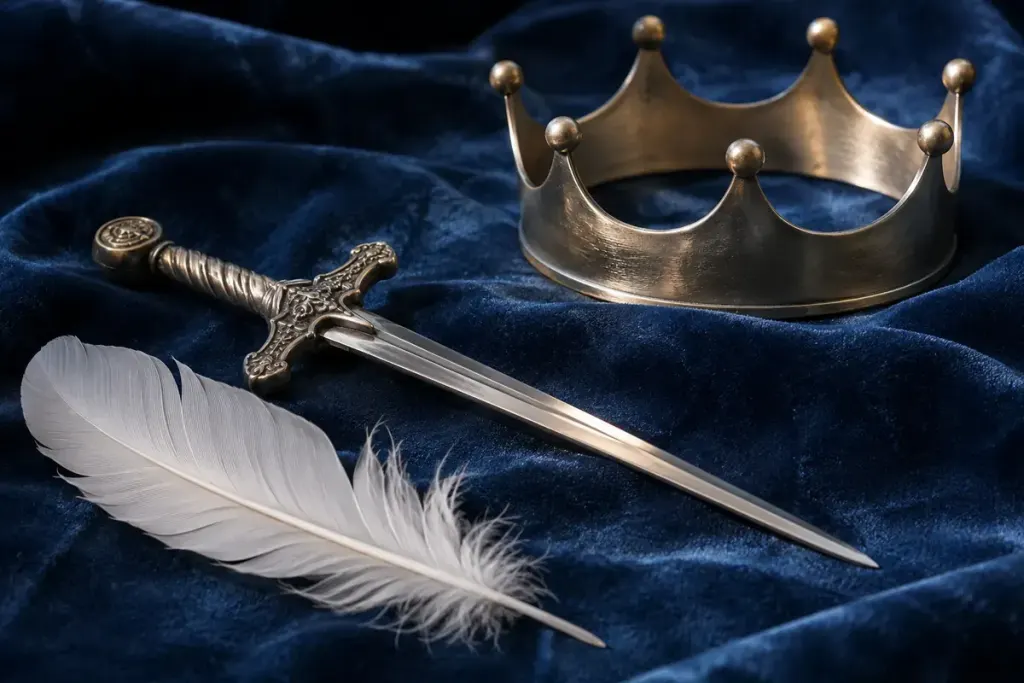
The Queen of Swords can be a useful card to sit with when a conversation needs clarity. That does not mean the card predicts conflict or identifies a particular person. A reflective reading begins with the image, then makes its own interpretation visible rather than presenting it as a fact about the future.
In A. E. Waite’s historical description, the queen holds a raised sword and extends her other hand. His associated meanings include sorrow and separation. Those meanings belong to a particular text and tradition; modern readers need not repeat its gendered assumptions as descriptions of people around them.
Try an observation before an interpretation
Look at the version in your own deck. Is the figure facing someone, looking away or meeting your gaze? How is the sword held? What does the open hand seem to offer? Write down what is actually drawn before deciding what it means. Another deck may change the posture or setting enough to suggest a different reading.
For this exercise, treat the sword as a possible image of distinction: separating what you know from what you assume. Treat the extended hand as a possible invitation to communicate. These are proposed readings, not universal definitions of the symbols.
Turn the image into a usable sentence
Choose a low-stakes situation and complete three prompts:
- The fact I can state clearly is…
- The limit I need to communicate is…
- The part I am still willing to discuss is…
An illustrative response might be: “I can help on Saturday morning, but I cannot stay all day. We can decide which task matters most.” The sentence is useful because it is specific, not because drawing a card makes it correct.
Put the card aside and read your sentence again. Does it respect both your needs and the other person’s freedom to respond? Tarot can provide a frame for reflection, but the responsibility for a decision remains with you. For medical, legal or financial questions, seek appropriate evidence and qualified advice rather than treating the card as an authority.