
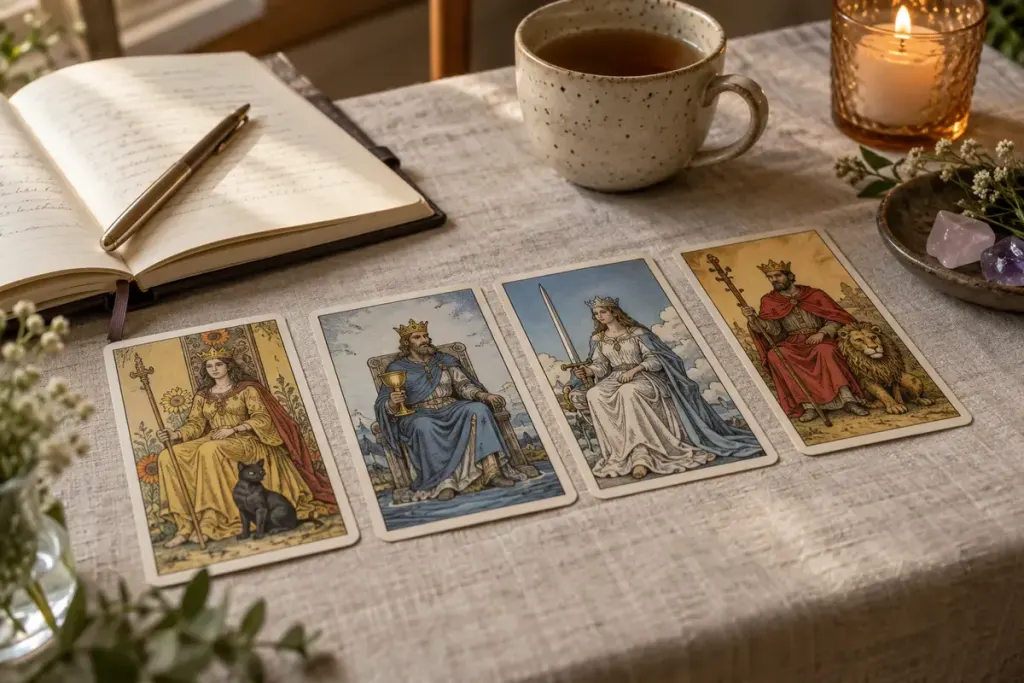
A court card appears, and the first question is often whether it represents a man or a woman. For a personal journaling exercise, there is another useful starting point: what role or behaviour does the image invite you to examine?
This is a reflective reading approach, not a claim that cards reveal facts about another person. Different decks and traditions use different titles and imagery. Read your deck’s own guide before deciding that a familiar-looking figure has a fixed meaning.
Describe what the figure is doing
Set aside the title briefly. Notice posture, direction of attention, objects and surroundings. Write an observation such as “the figure seems to be waiting before acting.” Then mark any interpretation as your own: “this makes me think about patience.” Keeping those two sentences separate prevents an impression from becoming an asserted fact.
Next, translate the idea into a role. A learner, organiser, protector or experimenter can be a role someone adopts in a particular situation. None of these roles requires a particular gender.
Bring the question back to your choices
For an invented example, imagine preparing for a difficult group project. Instead of asking which colleague a court card secretly identifies, ask: “Where do I need to listen first, and where do I need to make a clear decision?” Write one action that is within your control.
You can repeat the exercise with the same card on another day. A different response does not mean the earlier entry was wrong; it may show that you are approaching a different situation. Date the entries and describe the context so the journal remains understandable.
Avoid using the exercise to diagnose someone, decide what they believe or make financial or health decisions. When a question needs evidence or professional advice, seek that directly. A useful tarot reflection leaves you with a clearer personal question, not an unsupported label for somebody else.