
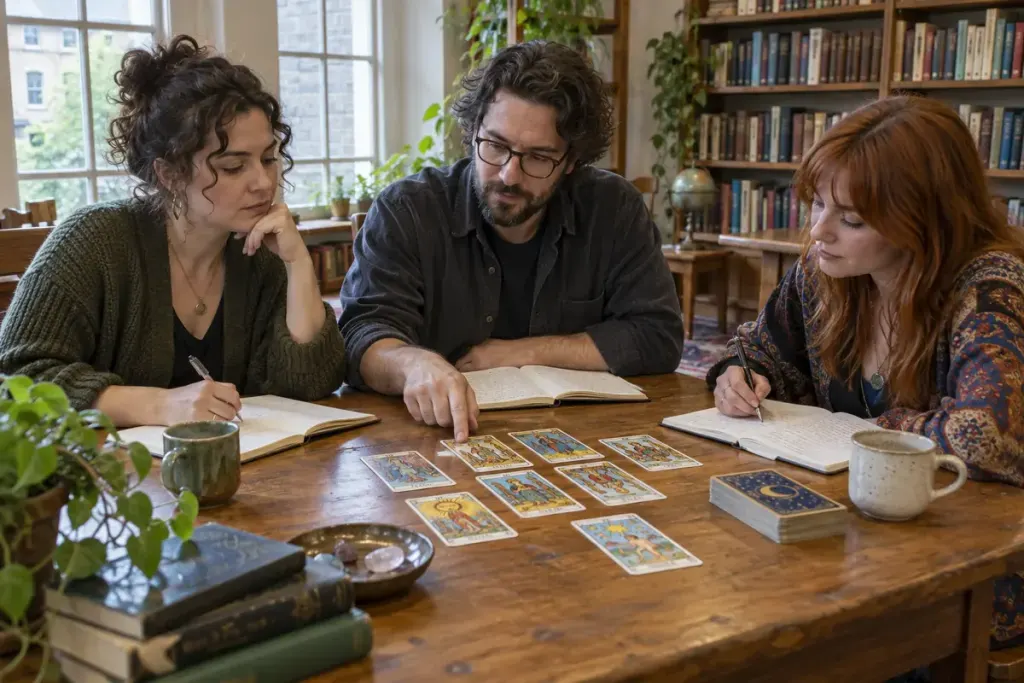
A tarot study group can become awkward when someone expects an art discussion and another expects a personal reading. Set the purpose before the cards reach the table. For a beginner session, comparing one illustration is enough to create a useful conversation without asking anyone to reveal a private concern.
Give everyone the same starting point
Choose one card from a deck you have permission to use in the session. Let everyone look quietly before opening the guidebook. Ask each participant to name one visible detail: a figure’s direction, an object, an open space or a repeated shape. Write interpretations separately from those observations.
For an illustrative exercise, one person may notice a doorway while another notices the figure standing away from it. Neither has to explain what the image means for their own life. The group is practising attention, not testing who can produce the most confident reading.
Use a small, repeatable session plan
- State the topic and the finishing time.
- Allow quiet looking before the first speaker offers an interpretation.
- Invite one observation from each person, with an easy option to pass.
- Compare those observations with the deck author’s explanation.
- End with a question to investigate at the next meeting.
Identify which deck and guidebook edition you are using. Different artists can make different visual choices, so disagreement between two illustrations is not necessarily a mistake that needs correcting.
Agree that participants will not interpret another person’s relationships, health or future without invitation. For this study format, keep the exercise with the picture even if someone offers a personal story. They can share as much or as little as they wish, and others should not treat the cards as evidence about them.
Afterwards, keep a shared note containing the card, the questions and the source consulted. Leave personal disclosures out of that record unless the person explicitly wants them included. A good first meeting leaves everyone comfortable returning, with something specific to notice next time.