
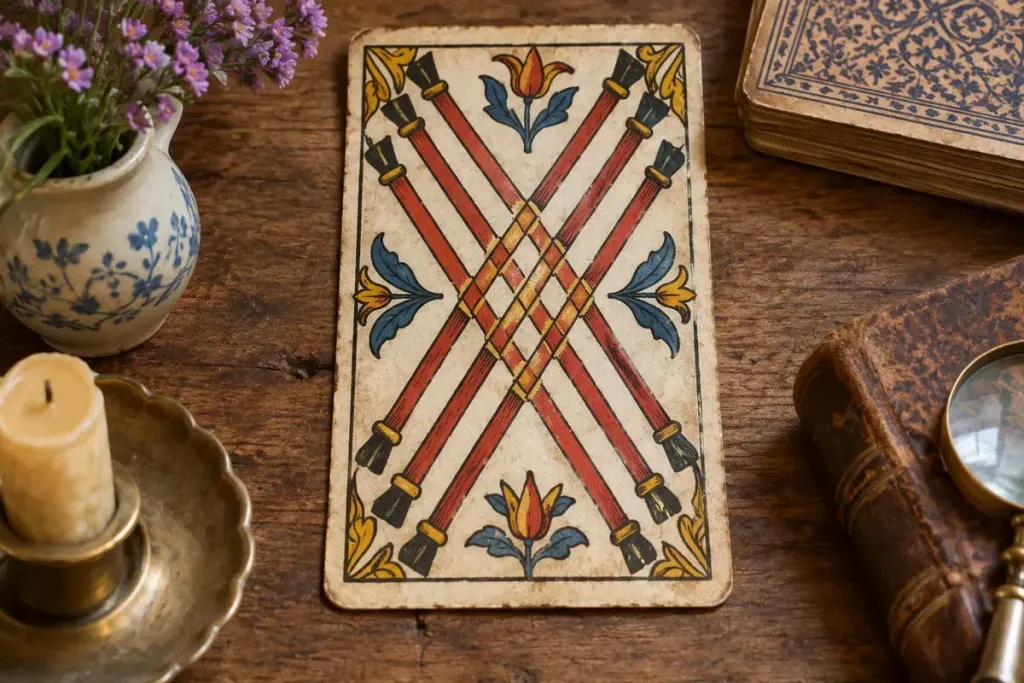
A Marseille-style batons card can initially look like a woven fence. Its crossed rods create a dense pattern, and decorative leaves can make it surprisingly easy to lose count.
Try this as a visual-study exercise with a deck you own. It does not require a prediction, a spread or an agreed symbolic meaning. Choose one numbered batons card and set its guidebook aside for the first few minutes.
Trace the rods, then the spaces
Follow one rod from end to end without drawing on the card. Notice where it appears to cross another and where the design places a central vertical element. Count the rods rather than counting every small shape formed by their intersections.
Next, look at the empty spaces. Which shapes repeat? Does the pattern feel symmetrical? Are the decorative forms separate from the rods, or do they seem to grow between them? Record only what you can actually point to in your edition. Details can differ between decks and reproductions.
Make a rough sketch on scrap paper. Artistic accuracy is unnecessary; the aim is to discover which features you had mentally skipped. Keep the card beside the sketch and correct one missed detail before moving to interpretation.
Separate description from association
Use two short columns in your notebook. In the first, write an observation such as ‘three diagonals cross three others’. In the second, write your personal association: perhaps structure, crowding, support or resistance. The association is yours; the drawing alone does not prove a universal meaning.
Now read the guidebook and note where it directs attention differently. You can agree, disagree or leave the question open. If you compare another edition, record its maker and title so you can find the same image later.
The result is a small, repeatable way of looking closely. It gives a visually complex pip card time to become a picture before it becomes a keyword.