
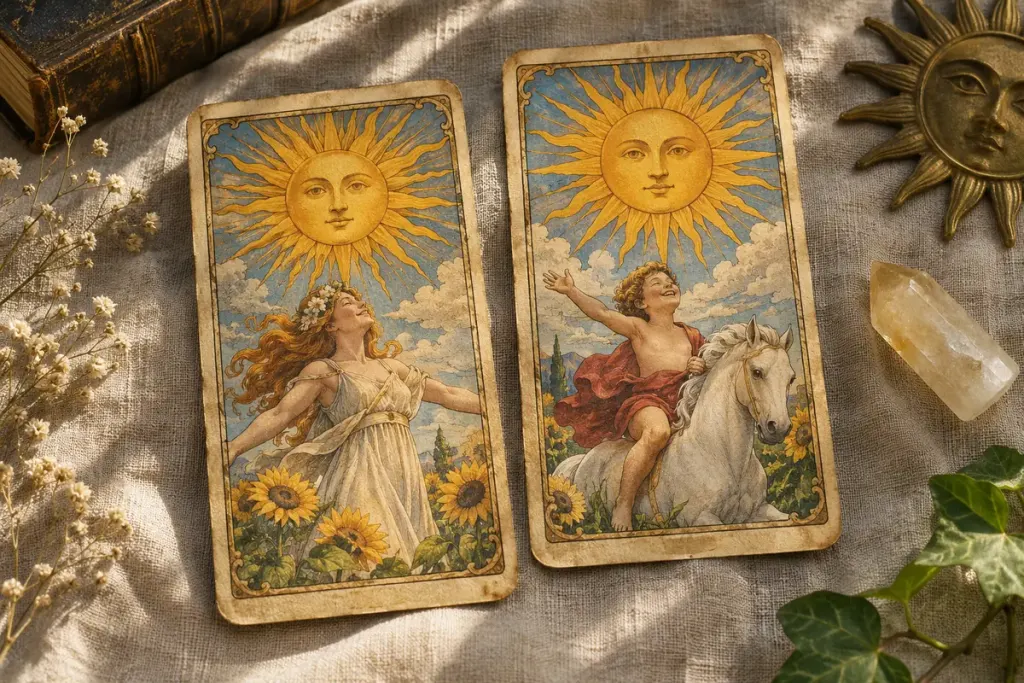
The Sun card is easy to reduce to one cheerful word. Looking below the large sun, however, reveals a more interesting exercise: who occupies the scene, what separates them from the background, and how does the artist direct your attention?
Tarot imagery changes between decks and editions. The V&A’s history of tarot cards places the Sun among the familiar subjects of the major arcana while showing the wider variety of tarot design. A shared card name does not make every illustration an identical message.
Describe before interpreting
Place your own Sun card beside a blank page. Spend a minute recording only visible details: the number of figures, their gestures, the ground, any wall or vegetation, and the direction of the rays. If an object is unclear, write that it is unclear instead of supplying the detail from another deck.
Then look at scale. Does the sun dominate the image, or does your eye go first to a face, a bright banner or an animal? Notice how the colours divide the card into foreground and distance.
Only after this description, add a second column for associations. You might connect an open gesture with welcome, or a boundary with shelter. These are your readings of visual choices, not facts about what will happen next week.
Compare two editions carefully
If you have access to a second deck, repeat the same observation rather than copying the first set of notes. Record the deck title, artist and edition. A recoloured reproduction can change emphasis even when the underlying drawing remains similar.
Choose one difference to explore. For example, ask how a scene with several interacting figures feels different from one centred on a single figure. Keep the question tied to what is actually printed on the cards you are studying.
This can also become a short journalling prompt: “What feels clear to me today, and what evidence supports that feeling?” The card supplies an image to think with; it should not replace evidence or professional advice for health, money or other consequential decisions.
Return to the first descriptive column after writing. It is often where the most distinctive part of the artwork was noticed, before a familiar keyword took over.