
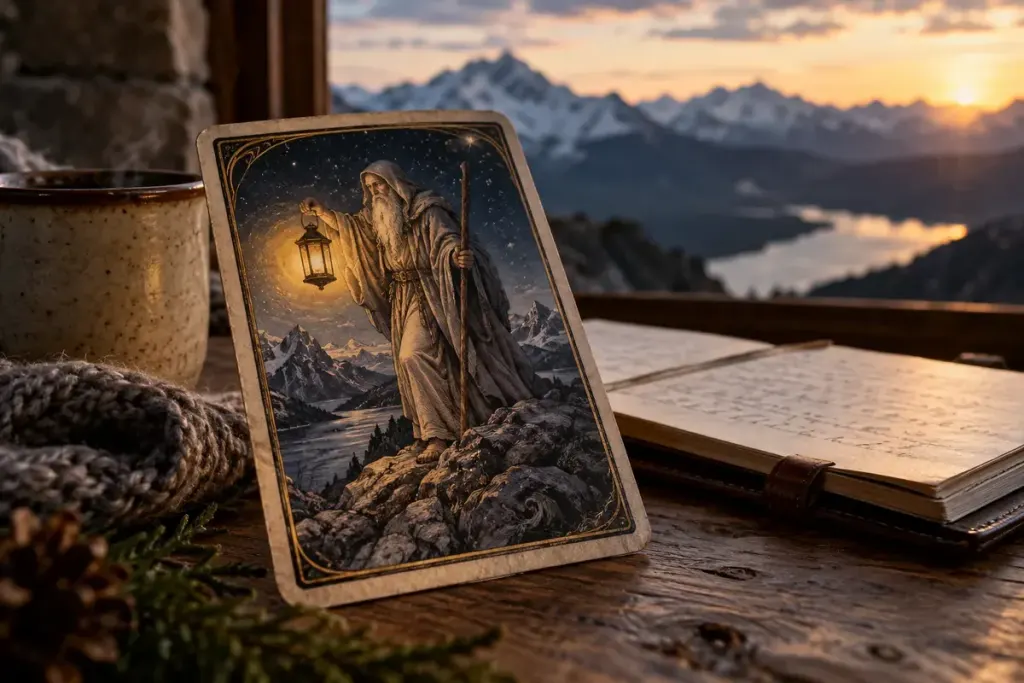
The Hermit is easy to reduce to a single word: solitude. Yet the lantern complicates that reading. A figure who holds a light where someone else might see it is doing more than merely withdrawing from company.
In A. E. Waite’s account of the Hermit, the lantern contains a star and the raised position matters to his interpretation. This is the explanation attached to a particular historical tarot system. It is not a universal key for every deck or evidence that a card predicts someone’s future.
Make three separate notes
- What the image shows. Record the lantern’s position, the figure’s gaze and the visible ground. Stay with details you can actually see in your edition.
- What the accompanying text says. Note the author and distinguish a guidebook’s interpretation from your observation.
- What it prompts you to consider. Write a question or association in your own words, leaving room to disagree with it later.
For example, an original reflection question might be: “Which part of this task is clear enough for one next step?” That is a use you choose to make of the image. It is not an instruction received from the card, and it should not replace practical information or professional advice.
Now compare a second deck if you have one. Is its light concealed, held high or absent? Does the figure seem to illuminate a path, signal to another person or examine something nearby? An artist can shift the emphasis without changing the card’s familiar name.
Keep those differences rather than forcing both pictures into the same sentence. Your notes may reveal that “Hermit” names a family of visual interpretations, not a single scene reproduced everywhere.
End the exercise by returning to the artwork once more. If your written meaning could have been produced without looking at the card at all, add one concrete visual detail. That small revision turns a memorised keyword into a closer study of the image.