
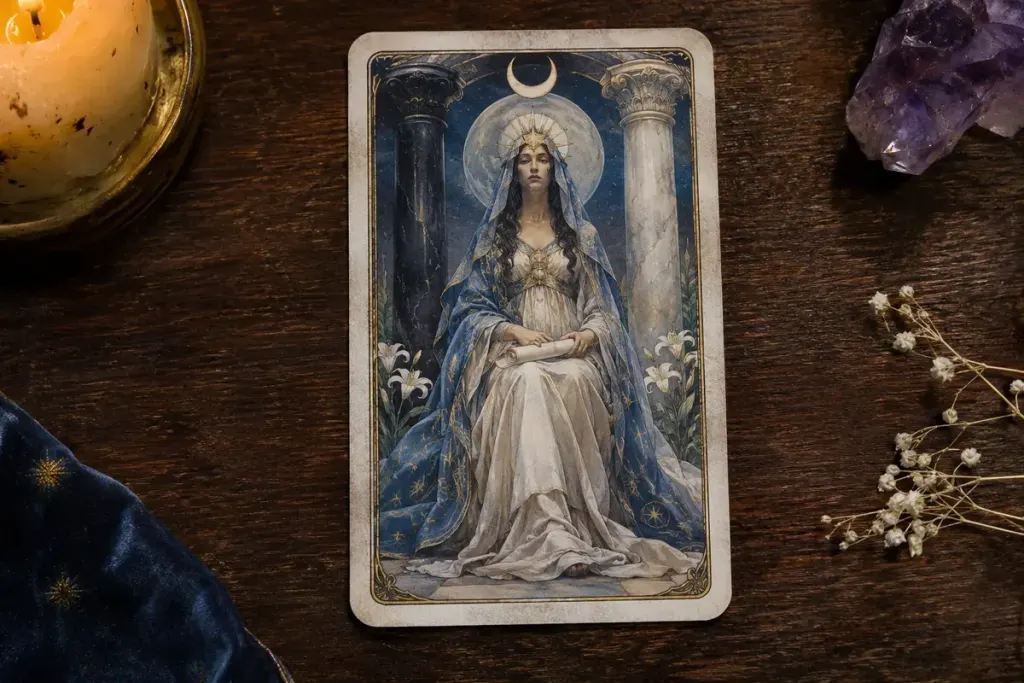
The High Priestess is often reduced to a single keyword before anyone has looked closely at the card. A more interesting exercise begins with what the picture allows you to see—and what it deliberately leaves partly concealed.
In A. E. Waite’s description in The Pictorial Key to the Tarot, the figure sits between contrasting pillars, with a veil behind her and a scroll partly covered by her clothing. This is a historical account of a particular tarot tradition, not proof of a card’s ability to reveal hidden facts.
Observation
First write observations: the figure is seated; two pillars frame her; part of an object is covered. Keep this column close to what is visibly present in the deck you own. Modern artists may change or omit details, so compare your actual card rather than an imagined universal version.
Interpretation and response
Next record the guidebook’s interpretation, identifying the author or deck. Finally add your own response. Perhaps the partly visible scroll makes you think about incomplete information, or the central figure suggests a pause before speaking. Those are reflective associations, not historical facts about the image.
Keeping the columns separate prevents a common shortcut: treating a personal reaction as though every artist and reader has always agreed with it.
Use the image to improve a question
A practical journalling prompt might be: “Which part of this situation have I observed, and which part am I filling in?” List the evidence available, the assumption you made and one ordinary way to obtain better information.
Do not use a card to diagnose another person’s motives or replace medical, financial or legal advice. Its value here is as a visual prompt for careful reflection. Finish by returning to the artwork: which small detail now holds your attention, and how did looking longer change your first impression?