
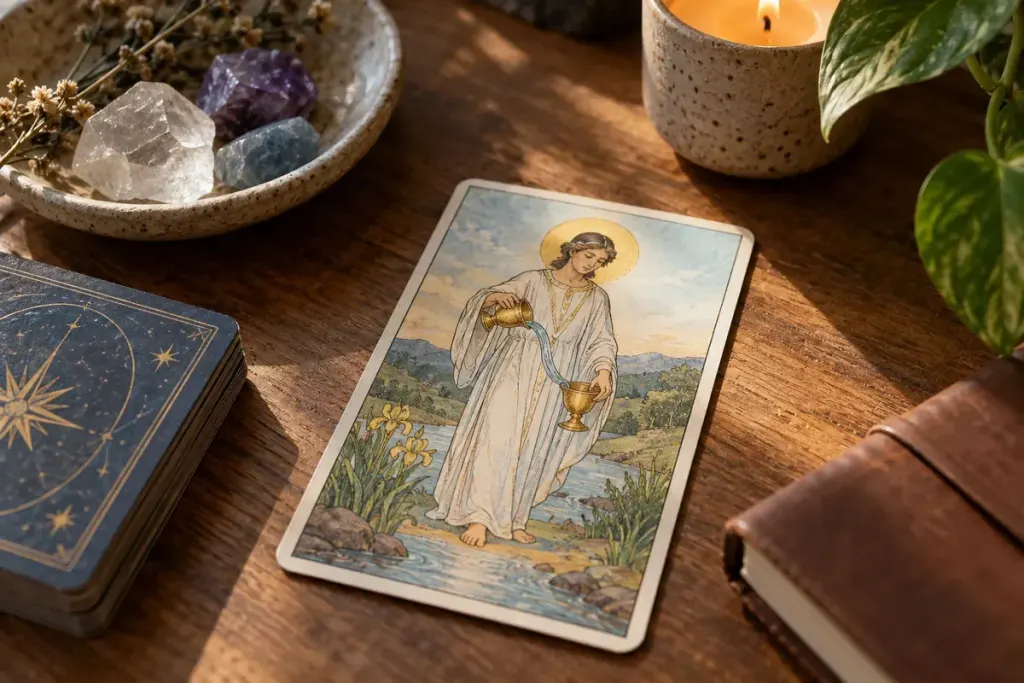
Temperance often draws attention to a small action: liquid moving between two vessels. Before looking for a fixed meaning, spend a moment with that movement. Which hand is higher? How wide is the gap? Does the pouring look effortless, deliberate or physically improbable?
The Morgan Library’s Temperance card from its Visconti-Sforza collection offers a historical image to study beside a contemporary deck. Use the museum’s attribution and dating when describing that particular object; a modern interpretation should not be presented as the artist’s documented intention.
Describe before you interpret
Make two short columns. In the first, record visible details: two containers, an angled arm, the direction of the stream, the figure’s posture. In the second, record your associations. “Careful transfer” is an association; “the upper vessel tilts” is an observation. Keeping them apart allows a different reading later.
Now compare a second version, if you have one. A changed vessel shape or a stream that seems to defy gravity may alter the image’s mood. The comparison is about what the artwork invites you to notice, not a contest to determine which deck has the correct message.
For a reflective exercise, choose one ordinary situation involving adjustment. Perhaps a busy afternoon needs room for both a task and a break. Ask, “What am I trying to transfer or combine, and what would a manageable amount look like?” Write a practical answer you can evaluate without consulting another card.
You do not have to interpret the image as a demand for moderation in every area of life. Balance can be an unhelpfully vague instruction when a real problem needs a concrete boundary or professional advice. Let the image generate a question, then use relevant evidence and your own judgment to answer it.
Date the note and return to it after the situation has changed. The interesting discovery may be that a detail you overlooked becomes more noticeable—not that the card predicted what happened.