
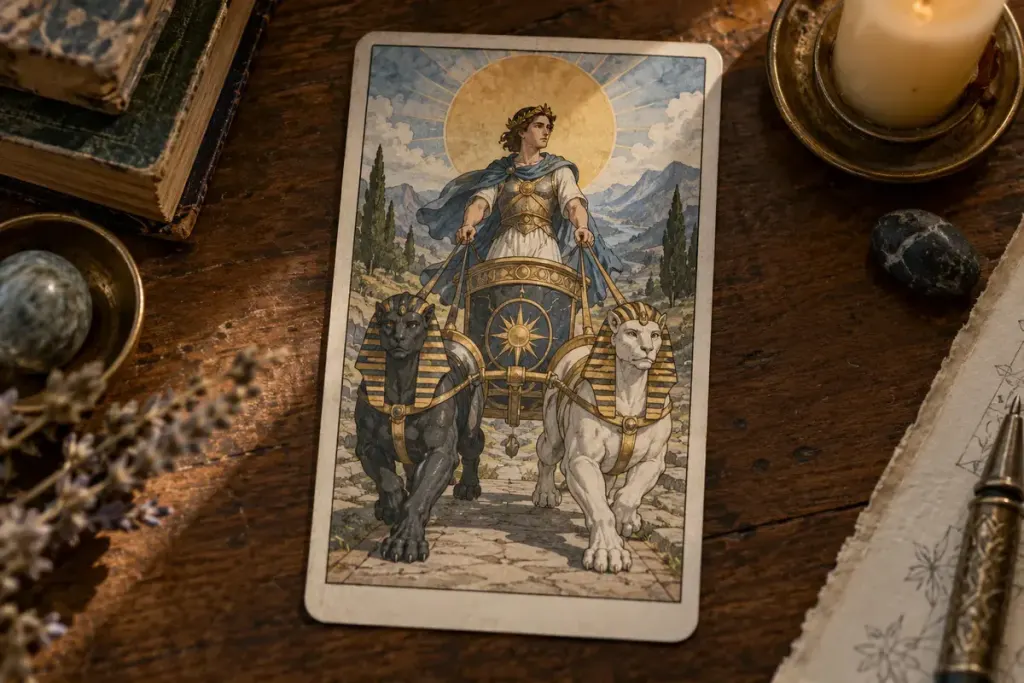
Before assigning the Chariot a meaning, look at what appears to move it. In some decks there are horses; in the familiar Waite-Smith imagery there are two contrasting sphinxes. Their placement gives the eye a relationship to explore before a guidebook supplies a keyword.
Historical designs are not identical. In A. E. Waite’s discussion of the Chariot, the animals and their changing forms are part of the card’s description. Reading that text as the work of a particular author is more useful than treating every interpretation as an ancient, universal rule.
Make two columns: visible and inferred
In the first column, record what the card actually shows. Are the animals facing forward? Are they alike? Can you see reins? Does the central figure stand still or appear to be actively directing them? In the second column, write the associations those details suggest to you.
For example, two differently coloured figures might suggest competing priorities. That is an interpretation, not something proved by the colour. A deck with different artwork may invite a different association. Keeping the columns separate makes your journal more honest and gives you something specific to compare later.
Now look at the whole composition. The canopy, wheels, posture and background may reinforce movement, ceremony or stillness. Notice whether your first impression changes when you stop concentrating only on the animals.
Turn the observation into a modest reflection
An optional prompt is: “Which two priorities am I trying to coordinate, and what practical action would help them work together?” Answer with a small, real situation rather than asking the card to establish another person’s intentions or forecast an outcome.
You might choose a study period that protects both rest and a deadline, or write down what information is missing before making a decision. The value lies in making your own thinking visible. Tarot imagery can support creative reflection, but it does not provide evidence about the future or replace medical, legal or financial advice.
Return to the card after writing. If your interpretation no longer fits the image, that is useful information about the story you brought to it.