
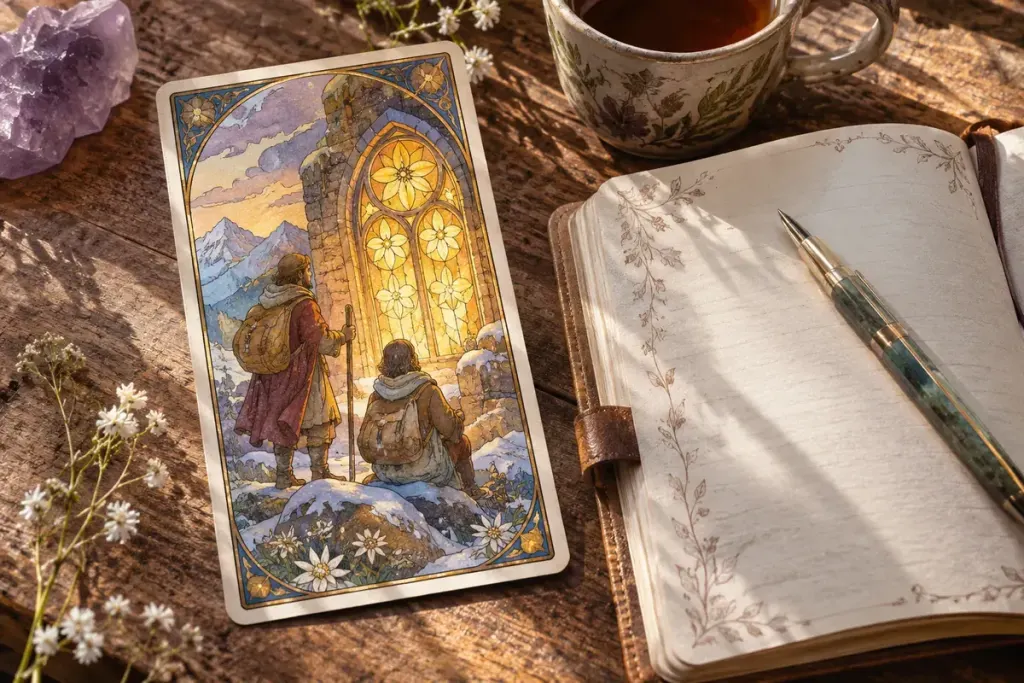
In the Waite–Smith Five of Pentacles, two figures move through snow beneath an illuminated window. The weather and their clothing establish hardship before any guidebook supplies a keyword. Yet the window introduces another visual element: light within the same scene.
A. E. Waite’s The Pictorial Key to the Tarot describes the figures passing a lighted window and records conflicting traditional interpretations. Reading that historical text does not require accepting its divinatory claims. It is useful evidence of how the deck was explained, rather than evidence that a card can predict a person’s finances or health.
Separate what is drawn from what you supply
Try making two columns in a notebook. In the first, record visible details: two people, falling snow, a window above them. In the second, record associations such as exclusion, companionship or possible shelter. The first column describes the image; the second contains your interpretation.
That distinction leaves room for an interesting question. Does the light feel available, distant or indifferent? The picture does not show the whole building, its entrance or what the people know. A confident story about why they have not gone inside adds information that the card itself does not provide.
A reflection that stays open
For a journalling exercise, choose one gentle prompt: “What help would be useful to name?” Then write a practical answer that could stand without the card. It might concern a conversation, a task shared with someone else or a resource you need to locate.
There is no need to force a positive ending onto the scene. Noticing support and acknowledging difficulty can coexist. Nor should hardship be interpreted as evidence that someone has failed to think positively enough.
Different decks redraw this card, sometimes changing the figures or removing the architectural setting. When comparing them, name the deck you are looking at. An interpretation grounded in one artist’s window may not fit a card that has no window at all.
The accompanying AI illustration is inspired by tarot imagery; it is not a reproduction of the Waite–Smith card discussed here.