
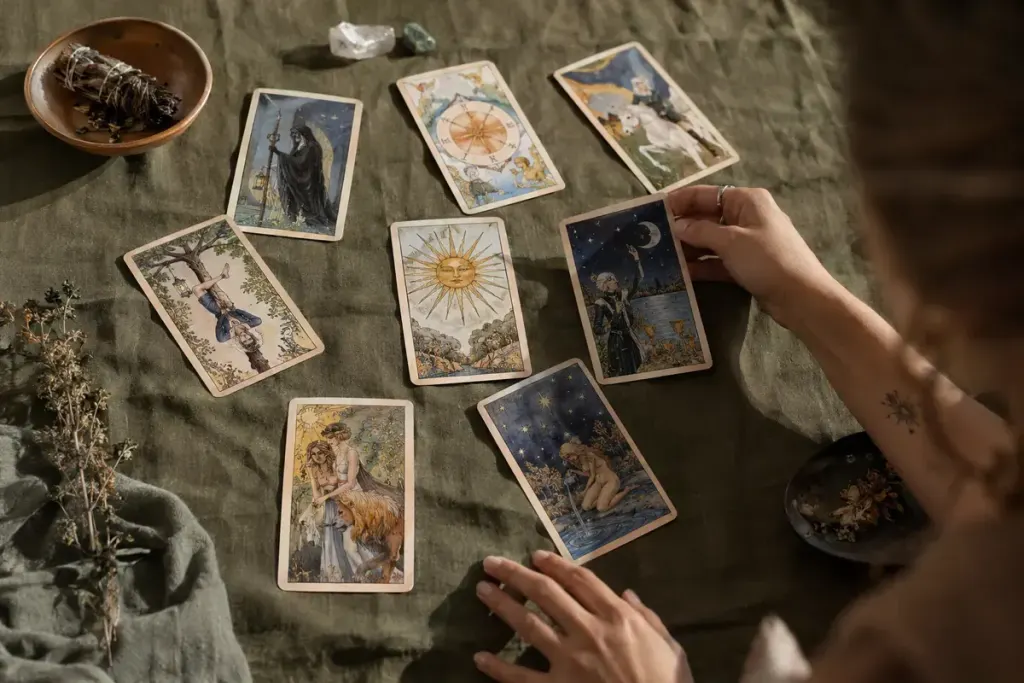
You turn over a card upside down and wonder whether that changes everything. In tarot practice, readers use different approaches to reversed cards. There is no need to adopt one simply because it sounds more advanced, and an upside-down picture does not establish a fact about your future.
Choose a method before seeing the cards
For a reflective exercise, you might read every card upright, follow a particular guidebook’s reversal system, or use orientation as a prompt to explore a contrasting perspective. Write your choice at the top of the page before drawing.
The important discipline is consistency. If you switch methods only when a card feels uncomfortable, the exercise becomes difficult to review. You can change your practice later, but label that as a new approach rather than quietly rewriting what the earlier spread meant.
A reversal does not have to mean the opposite
Different authors may associate reversals with delay, inward attention, excess or some other interpretation. Those are conventions of an interpretive system, not verified properties of the card. If you use a guidebook, identify the author and keep their interpretation separate from your own association.
Consider a fictional journaling prompt about patience. An upright reading might invite you to notice where waiting is useful; a contrasting prompt could ask where waiting has become avoidance. Both questions can be explored through ordinary evidence and reflection. Neither tells you what another person secretly thinks.
Review the practice without chasing a verdict
After the exercise, ask whether the chosen method produced a clear question you could actually consider. If it only created anxiety or a demand to redraw until the answer felt right, stop and return to the issue without the cards.
Keep consequential health, money and relationship decisions grounded in appropriate information and direct conversation. A reversal system is optional structure for a symbolic activity. Its value lies in the quality of the reflection it supports, not in making an uncertain situation look certain.