
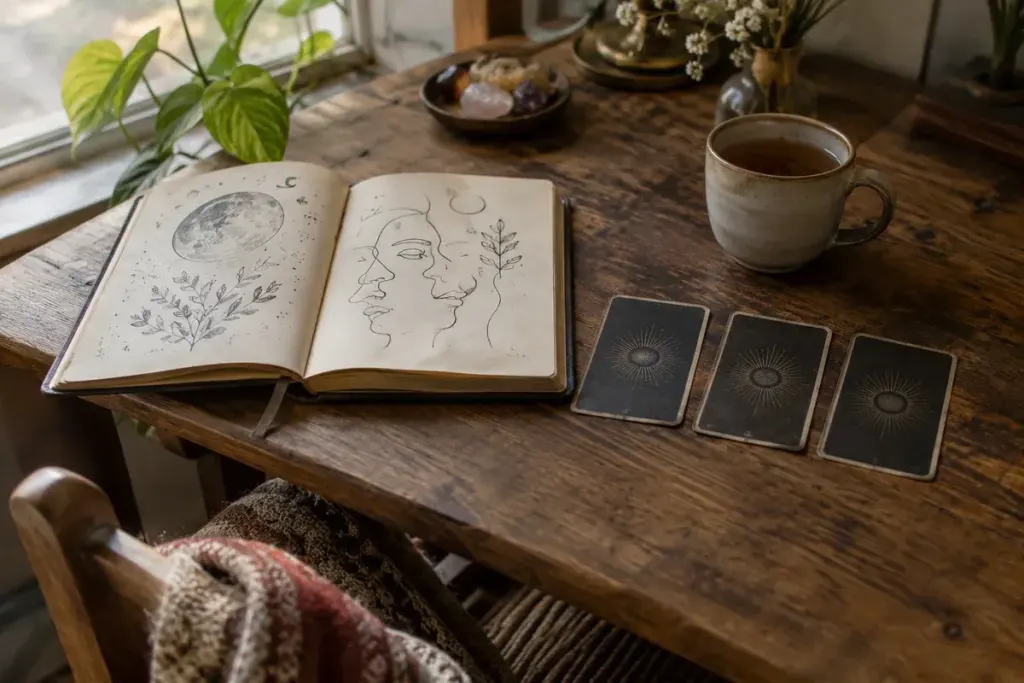
A modern tarot deck may arrive with a guidebook full of spiritual language. That can make it easy to assume the cards have always been used in exactly the same way. Their history is more interesting than a single, unbroken story of divination.
The Victoria and Albert Museum’s history of tarot cards traces their origins as playing cards in fifteenth-century Italy and their later association with fortune-telling. That distinction opens a useful question: which part of a deck belongs to its historical setting, and which part is a later interpretation?
Read the object before the legend
A museum record may identify a place, approximate date, material and maker or workshop. Those details establish what is known about a particular surviving object. They do not automatically explain every image or prove the meaning assigned to it by a contemporary guidebook.
When comparing accounts, keep three columns in a notebook: documented information, the writer’s interpretation and your own response. This simple separation allows curiosity without turning a compelling story into an established fact.
Notice how a familiar word changes context
A card used within a game has a role in a system of play. A similar image in a reflective reading can become a prompt for a personal question. The visual resemblance does not make those activities historically identical.
Imagine finding an old card with a striking figure. You might feel it represents confidence, while the catalogue explains its place in a historical pack. Both observations can be recorded, but only one is your present-day association. Writing “this makes me think of” is more accurate than claiming “this has always meant.”
Ask what the modern edition adds
Look at the publisher’s notes, artist statement and acknowledgments. Is the deck a reproduction, a reinterpretation or a new work inspired by older imagery? Have titles, colours or figures changed? An edition can be creatively valuable without presenting itself as an untouched ancient system.
If a guidebook makes a historical claim, follow its reference to a museum, archive or scholarly source where possible. A claim repeated across several retail pages may still come from one unsupported description.
Understanding the history need not remove personal meaning from the cards. It gives that meaning a clearer place: something you bring to an evolving visual tradition, rather than proof that the deck can reveal hidden facts or determine your future.