
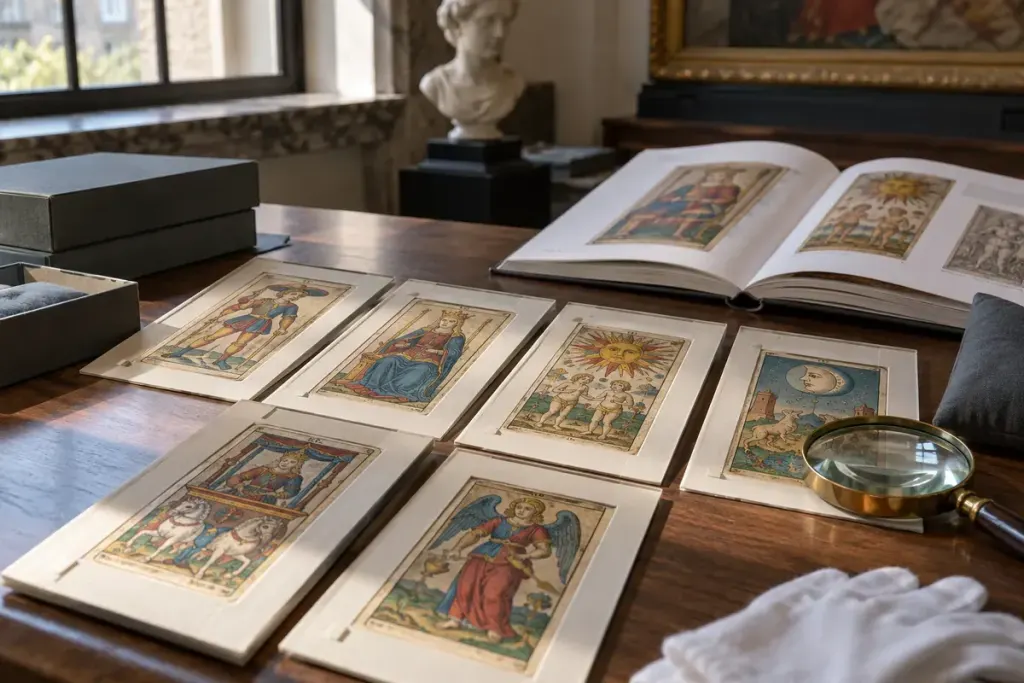
A modern tarot deck arrives as a complete object in one box. A historical deck may be known through surviving cards held in different collections, with gaps that later publishers reconstruct. That distinction changes how you read a museum image, a catalogue description or a reproduction deck.
The Morgan Library & Museum’s Visconti-Sforza catalogue record describes fifteenth-century painted cards and their relationship to cards in other collections. The museum’s 2026 exhibition announcement discusses bringing holdings together. A digital gallery or an exhibition can therefore reunite part of a visual sequence without implying that the originals have always remained together.
Keep the object separate from the modern pack
The Morgan Shop’s reproduction-deck description distinguishes surviving cards from recreated replacements for missing ones. That is a useful detail to look for in any historical facsimile: which images reproduce an extant object, and which complete the pack through later interpretation?
Do not assume a printed card number, title or uniform back reproduces the original exactly. Check the publisher’s explanation and the collection record. A modern edition may make practical choices so the pack can be used, while the museum documents the historical objects individually.
For a study note, record the institution, accession number, object title, stated date range and the edition you are viewing. Mark uncertainty as the catalogue presents it. “Attributed to” and “dated approximately” should not become a definite artist and year merely because a short caption looks neater.
Compare one card’s catalogue image with the corresponding reproduction if you have lawful access to both. Look for cropping, colour treatment and added labels, describing only what you can actually observe. A difference in a photograph may come from reproduction conditions rather than a change to the object.
This approach makes historical tarot interesting as material culture as well as imagery. The question becomes how the cards survived, were catalogued and were reassembled for modern readers, rather than assuming every complete deck is an unchanged window into the past.