
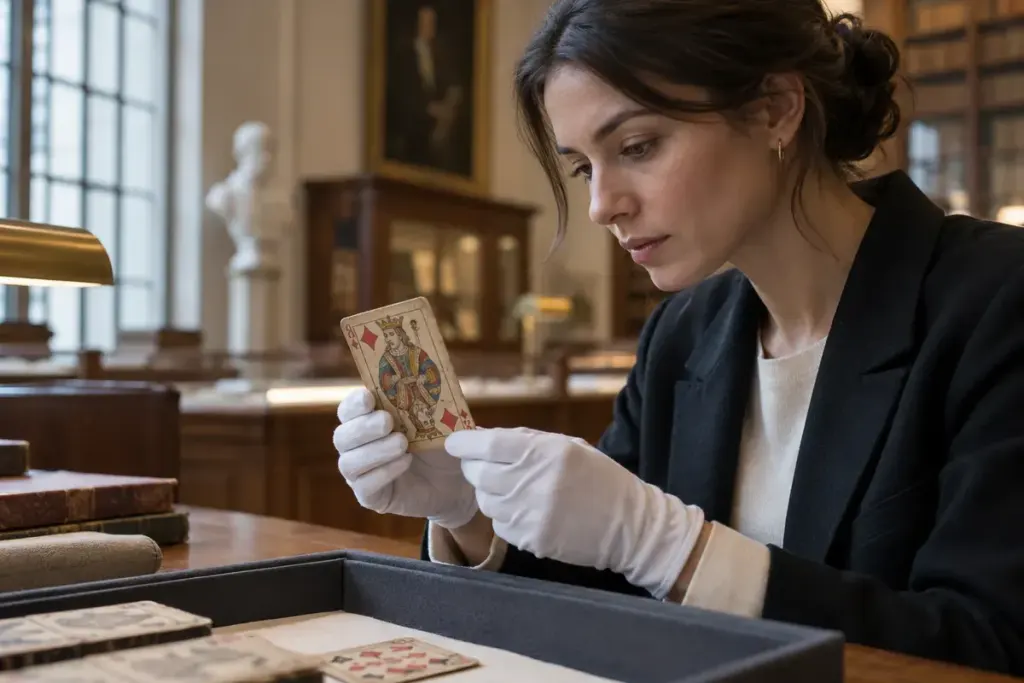
A catalogue places a famous painter’s name beside an early tarot card. Before copying that name into your study journal, look for the words around it. “Attributed to,” “workshop of” and “by” do not make identical claims.
The Morgan Library’s record for the Visconti-Sforza tarot cards discusses competing attributions and scholarly disagreements about cards in the surviving group. It offers a useful reminder that a catalogue can preserve uncertainty rather than resolve every question into one permanent answer.
Keep the qualification with the claim
Write the attribution as the institution presents it, together with the object number and the date you consulted the record. Do not shorten a qualified statement into a certain one merely to make a caption cleaner. A later catalogue update may reflect new research or a changed interpretation.
Separate the proposed artist from the proposed date, place and patron. Evidence for one does not automatically settle all the others. A family emblem may support an association with a patron while leaving the identity of the painter debated.
Make a two-column reading note
In one column, record what you can see: painted gold, costume details, damage or a particular emblem. In the other, record the catalogue’s interpretation and its degree of certainty. This keeps your visual observation from quietly becoming historical proof.
If two reputable records differ, note both rather than choosing whichever tells the more dramatic story. Check publication dates and whether the authors are discussing the same card, the same group or a later replacement.
The exercise can enrich a tarot study without making historical research into a contest for a definitive origin. A careful sentence such as “the museum discusses several proposed artists” is more informative than a confident name detached from the evidence that made it provisional.