
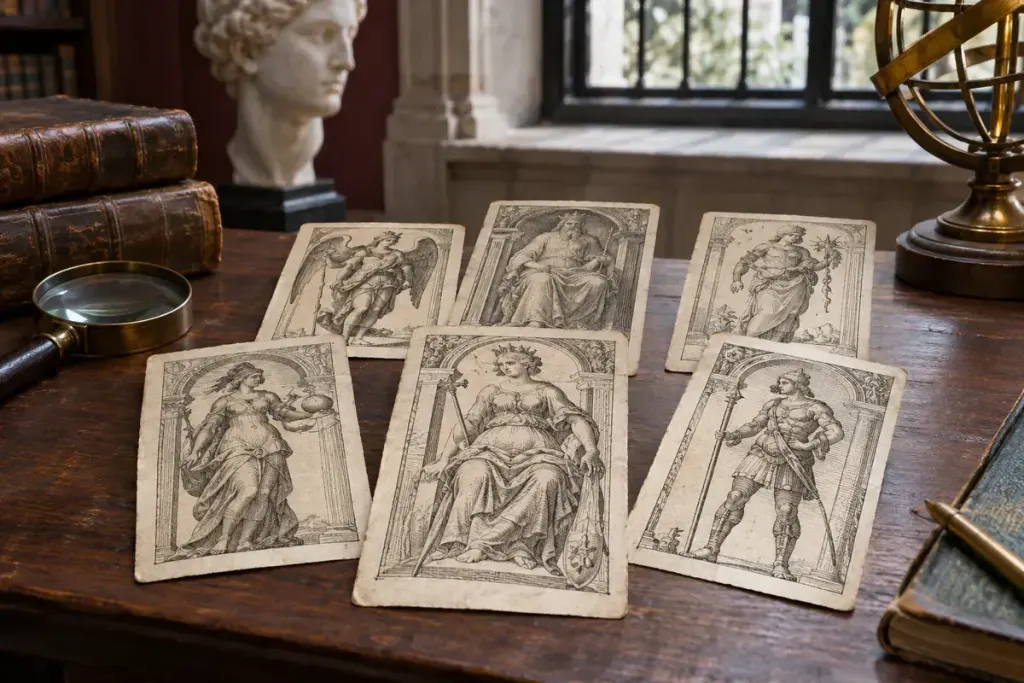
A product labelled Mantegna Tarocchi may tempt a reader to look immediately for familiar suits and court cards. The historical series asks for a different kind of attention. Its conventional name does not make it an ordinary tarot pack, and the attribution in that name is misleading too.
The Metropolitan Museum of Art’s entry for Poetry from the series describes fifty engravings, not designed by Andrea Mantegna and lacking the usual suits, number cards and face cards. The museum presents a didactic game or instructional booklet as possible uses, rather than claiming one purpose is settled.
Read a sequence before assigning a spread
Look at how human roles, arts and other personifications are organised. The Met’s example places Poetry within an expanded group of arts and sciences. That context gives the image a relationship to its neighbours which can disappear when a modern reproduction is treated as an isolated fortune-telling card.
A useful study page has three columns: what you can see, what the museum catalogue identifies, and your own response. Keep those categories separate. “A figure holds an instrument” is an observation; a named allegory is a catalogue identification; “this makes me think about practice” is a personal interpretation.
Check the reproduction you are using
Read the publisher’s description for the source series, added text, colouring and any changes to the number or order of images. A modern set can be useful for reflection without reproducing every feature of a historical object. Record the edition so that another reader knows which images you mean.
You might choose one engraving and write a short reflection on what knowledge or skill it represents to you. Label that exercise as your present-day practice. It does not need an invented claim that Renaissance users performed the same exercise.
The reward of this approach is a richer encounter with the artwork: less effort forcing it into a familiar deck structure, and more attention to the historical questions its unusual organisation raises.