
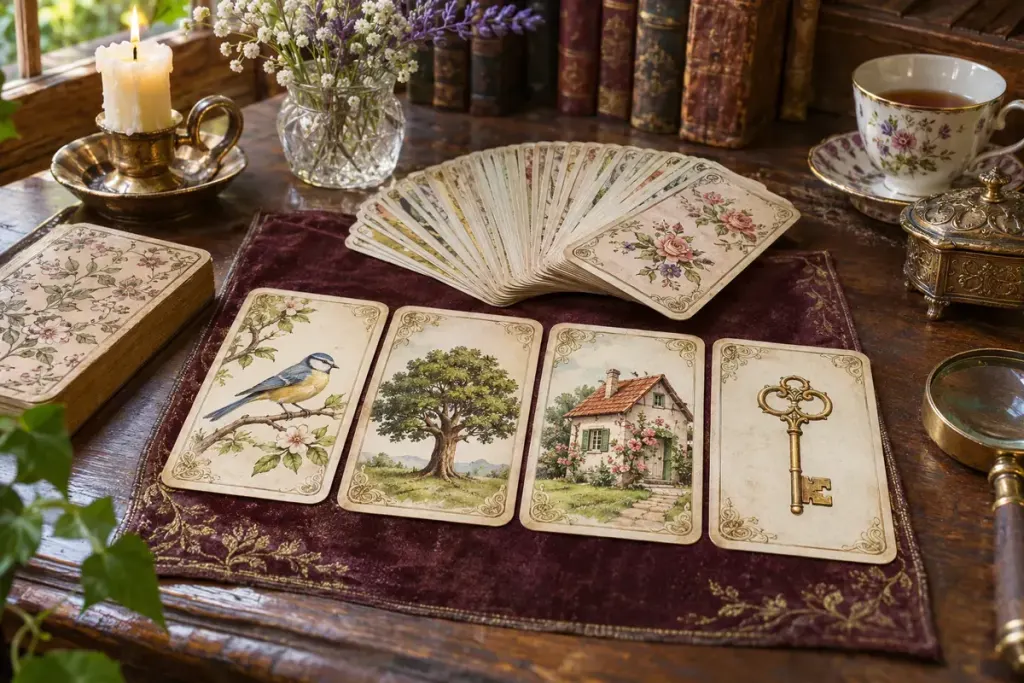
A bird, a house, a key and a tree look immediately recognisable on a Lenormand card. That familiarity can tempt a tarot reader to treat the pack as a smaller tarot deck. A more useful beginning is to notice what the pack actually contains before bringing another system’s structure to it.
Begin with the pack, not a prediction
The commonly encountered Petit Lenormand format contains 36 cards. Its history is associated with the earlier Game of Hope. The British Museum’s surviving Game of Hope pack provides a material reference for looking at the numbered pictures and playing-card inserts.
It is worth distinguishing that object from later publications carrying the Lenormand name. A famous name on a modern box does not establish that the named person designed that edition or its images.
Try a small visual inventory
Choose four cards and describe only what you can see. Is the key large or small? Is the house occupied? Does the tree fill the frame or sit in a landscape? Write those observations separately from any meanings assigned by the deck’s guidebook.
Next compare the same numbered card in two editions. The core subject may stay recognisable while colour, scale and mood change. This is an enjoyable way to study an illustrator’s decisions without claiming that one version can establish a fact about someone’s future.
A guidebook may teach combinations and reading conventions specific to its tradition. Keep those conventions labelled as interpretation. They are not observations in the same sense as counting the cards or identifying a printed suit symbol.
Keep the historical questions modest
When researching an older pack, look for a collection record, publisher, date range and description of the printing method. Separate an object’s documented history from a story repeated in a retailer’s description. If a date is approximate, retain that uncertainty in your notes.
For reflective use, the pictures can prompt a question or a piece of writing: what does “home” mean in the situation you are considering? That can be a creative exercise without treating the cards as evidence about another person’s intentions, health or decisions. Let the images open a conversation rather than close it with a supposed certainty.