
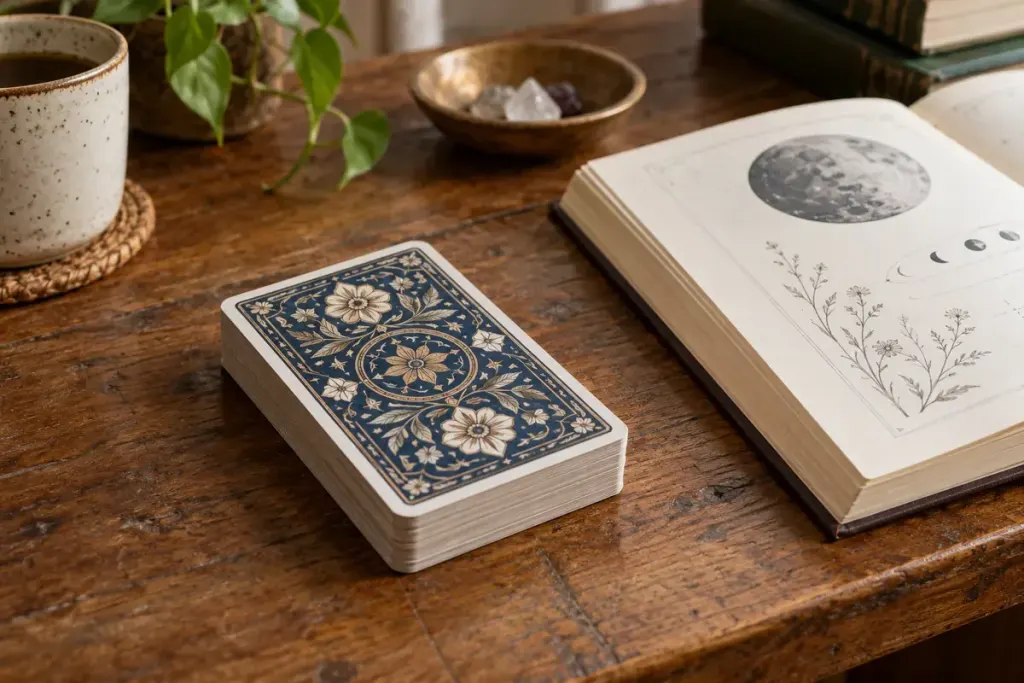
You admire the artwork in a tarot deck, then notice that the name on its box belongs to the guidebook’s author. Before describing the deck to someone else, take a moment to find out who contributed what.
Credits are a useful starting point for studying a particular edition. Look inside the guidebook, on the box and on the publisher’s listing. Record the roles actually given rather than assuming a single prominent name created every element.
Make a small credit card for the deck
Note the title, edition, publisher and any separately credited illustrator, writer or translator. If a role is not stated, leave it unknown. A retailer’s shortened product title may omit information found in the book itself.
This becomes especially helpful when comparing two editions. A new cover does not tell you whether the card artwork or accompanying text has changed. Compare the contents and publication details before treating the editions as identical or different.
Ask where an interpretation came from
Suppose a guidebook describes a landscape as a place of retreat, while your attention goes to the figure’s posture. In your notes, distinguish the author’s explanation from your own visual response. Neither needs to be presented as a statement made by the illustrator unless you have a relevant interview or commentary.
When sharing a review, name the artwork’s creator where the credit is available. Describe specific details in your own words. Owning a deck does not automatically give permission to reproduce all its images or copy its guidebook; check the relevant permissions before publishing substantial reproductions.
A simple closing note might read: “I am responding to the colour and composition of this edition; the written interpretation is a separate contribution.” That makes your review more precise without requiring a biography of everyone involved.
Studying credits treats a deck as a made object with identifiable creative decisions. It does not establish that its images can predict events or reveal another person’s thoughts.