
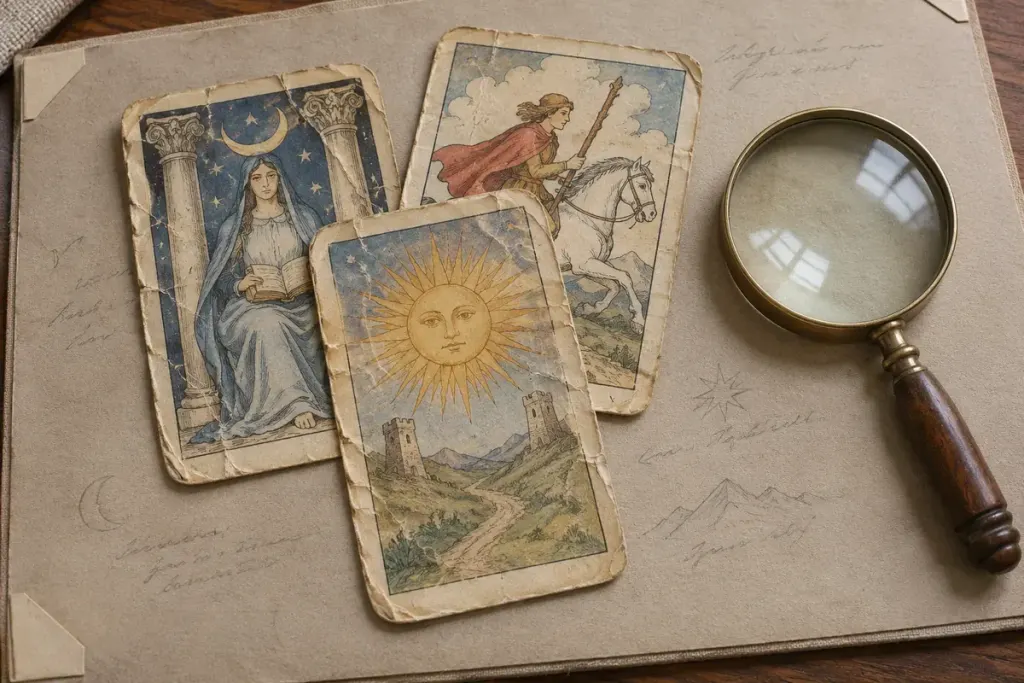
A pencil word beside a card’s printed title can change how you look at the whole deck. Someone paused over this image and added something. That is interesting evidence of use, even when you cannot identify the person who held the pencil.
When examining a second-hand deck, begin with what is visible. Record the card, the position of the note and the words you can read. Put uncertain letters in your own notes rather than silently filling them in. A short word might be a translation, a mnemonic, a personal association or something unrelated to divination.
Keep observation and interpretation on separate lines
For an imagined example, suppose three cards carry the same small star in one corner. Your observation is that the marks share a location and shape. “These were the owner’s favourite cards” is a possible interpretation, but the marks alone do not establish it. They might instead identify cards selected for a lesson or a game.
Compare the handwriting across the deck without assuming that it all belongs to one person. Look for changes in ink, pressure or placement, while remembering that one writer can use different pens at different times. A printed publication date dates the edition, not necessarily the annotation.
If a seller supplies a history, keep the wording and its source alongside your photographs. Separate a documented ownership trail from a charming story. Do not upgrade “possibly used by a teacher” into a named provenance because it makes the deck feel more special.
Let the record remain intact
Avoid erasing marks, tracing over faint words or applying cleaning products to make a photograph clearer. For a valuable or fragile deck, ask a qualified paper conservator before attempting treatment. You can make a transcription or annotated digital copy without changing the original card.
For your own reflective practice, an old annotation can become a prompt: what do you notice before reading someone else’s word, and what changes afterwards? Keep that present-day response labelled as yours. The pleasure of a used deck lies partly in the distance between its printed imagery, another reader’s trace and the meaning you make now.