
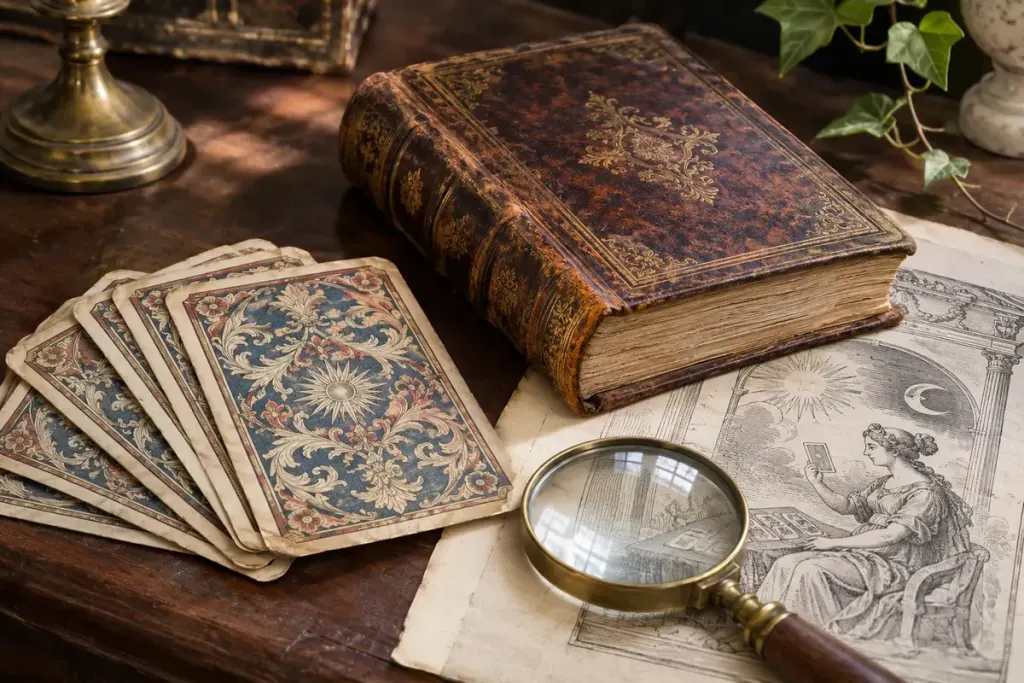
Etteilla appears frequently in tarot histories, but a date beside his name needs a second question: which book, and which cards? His early published work on card divination should not automatically be described as a tarot manual.
The Bibliothèque nationale de France catalogue records a 1770 work under the name Etteilla concerning fortune-telling with a pack of cards. A separate French catalogue record for his tarot-related work identifies an eighteenth-century publication about recreation with the cards called tarots. These are useful anchors for a reading list, but they should not be collapsed into one title and one date.
Read a catalogue entry as evidence
Make a small record with four fields: the title as printed, the author name used, the publication date attached to that edition and the library holding the copy. If a modern article gives a different date, check whether it means the first edition, a later issue or another volume.
A fictional research note might say, “The library lists this edition in 1785; I have not yet checked whether an earlier edition exists.” That sentence preserves the limit of the evidence. “The practice began in 1785” would make a much larger claim that the catalogue cannot establish.
Separate historical influence from predictive claims
Studying Etteilla can illuminate how card-reading systems were organised, named and circulated in print. It does not establish that a reading predicts events. Likewise, a later deck associated with his system is not automatically an exact reproduction of every feature in an early book.
When buying a modern edition, look for an introduction explaining the source text and editorial changes. Translation, redrawn imagery and reordered material can all affect what is in your hands. A useful historical reading session ends with a clearer connection between the object, its publication record and the claims made about it—not simply an older-looking date on the cover.