
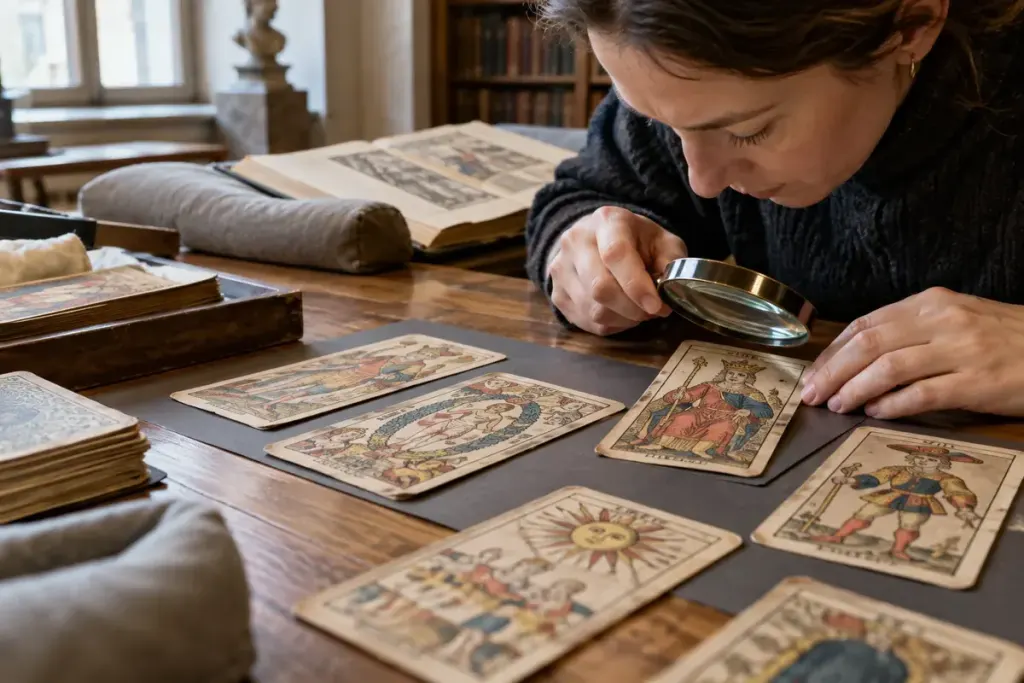
Before interpreting a card’s symbols, look at the marks that carry them. A bold outline, a flat area of colour and a small irregularity in a border may invite questions about how the image was produced.
The Metropolitan Museum’s catalogue on early playing cards includes a fifteenth-century North Italian tarot sheet described as a woodcut on paper. It also documents hand-painted luxury tarot cards. Historical cards were not all made by one process.
Separate the object from the reproduction
A modern deck can reproduce the appearance of an old print while being manufactured by a different method. Its visible lines may tell you about the source design, but they do not prove that the card in your hand was printed from a carved wooden block.
Read the museum or publisher’s medium description alongside the image. Record the creator if known, approximate date, material and whether you are viewing an original, a facsimile or an adaptation. A missing attribution is a gap to acknowledge, not a space to fill with a convincing story.
Try a material-focused comparison
Choose two openly accessible catalogue images. Without making a symbolic reading, note how outlines define clothing, whether colour follows or crosses those outlines, and how much detail remains legible at card size. Use neutral observations such as “thick outer contour” instead of immediately assigning a psychological meaning.
For an illustrative notebook entry, keep two columns: what the catalogue states and what you notice. “Medium: woodcut” belongs in the first when the institution identifies it that way. “The border looks uneven in this photograph” belongs in the second and may require a closer image before any conclusion.
Do not handle or alter a valuable card to inspect its construction. Use collection photography or seek appropriate conservation advice.
This kind of looking expands tarot study beyond a list of meanings. It recognises the card as an image made through materials, labour and reproduction, while leaving unsupported claims about its origin out of the reading.