
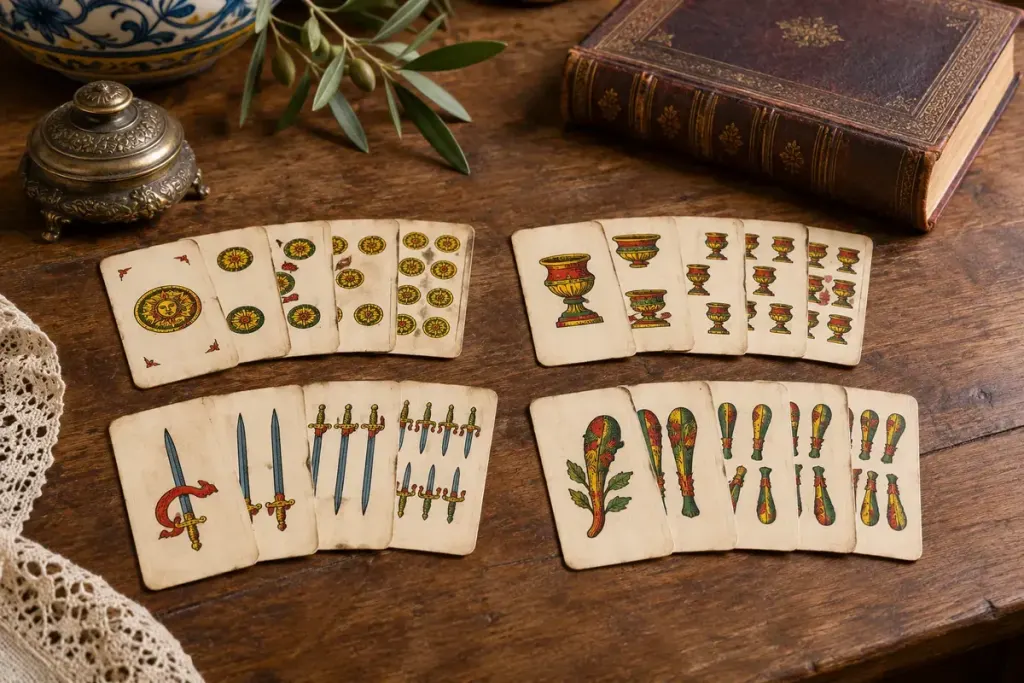
Count a Bolognese tarot pack and the familiar expectation of 78 cards will not help. Its 62-card structure belongs to a regional card-playing tradition. The difference is an invitation to study the pack on its own terms, rather than treating it as a modern deck with missing pieces.
Princeton’s Graphic Arts account of an early rules book places Tarocchino within the Bologna variation of tarot play. The smaller number of cards is part of the tradition being described, not evidence that a particular surviving copy is incomplete.
The International Playing-Card Society’s pattern sheet explains that numeral cards two through five are omitted from each ordinary suit. Removing four ranks from four suits accounts for sixteen cards: 78 becomes 62.
That arithmetic is a useful first exercise when examining a documented reproduction. Separate the suits, list the ranks actually present and compare them with the maker’s inventory. Keep the trumps and other special cards in their own group while you establish the structure.
Study a local pattern before importing meanings
Names, pictures and game functions can differ across tarot traditions. A guide written for a modern divination deck may offer a personal reflective framework, but it is not automatically historical evidence for how a Bolognese card was understood or played.
For an original study note, choose one card and make three short entries: what you can see, what the catalogue says and what the image makes you think about. Keeping those entries separate lets personal reflection coexist with careful historical reading.
Record the edition, publisher and source of any reproduction you use. A contemporary printing may interpret older artwork, and a historical text may describe a particular period rather than every later game. The compact pack rewards close attention precisely because it interrupts the assumption that tarot has always meant one fixed set of images and rules.