
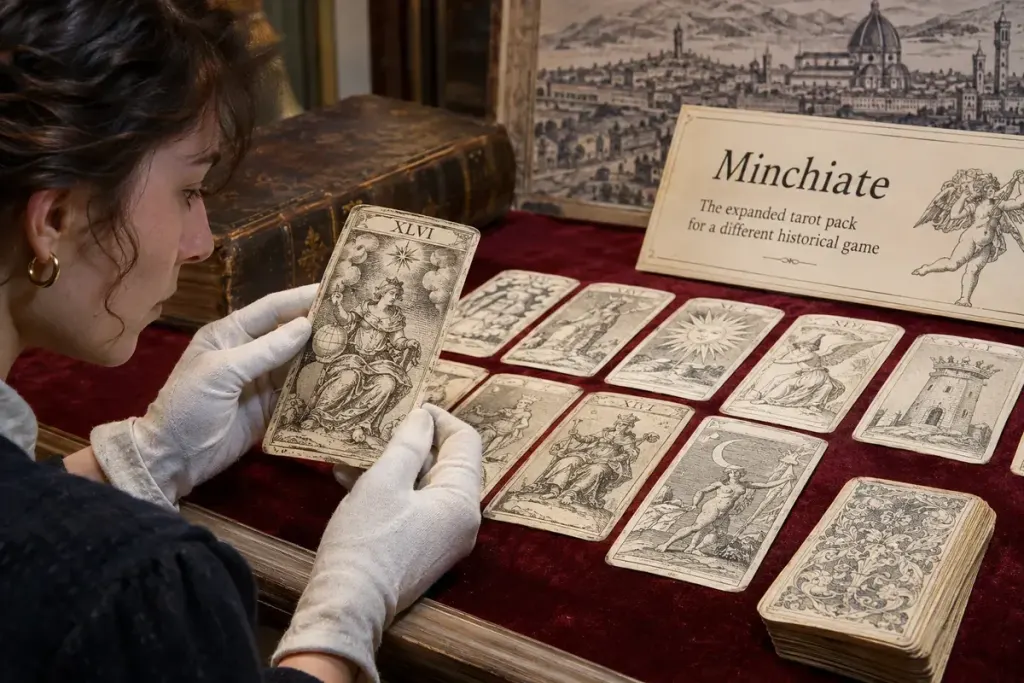
A deck containing zodiac signs and extra virtues may look like a modern remix of tarot. Minchiate is a reminder that expanded card packs also have a much older history. Before assigning familiar meanings to every image, it helps to ask what sort of pack you are holding.
The Victoria and Albert Museum’s history of tarot cards discusses Minchiate as a Florentine game with a 97-card pack. Its imagery includes additions such as the elements and zodiac signs. The museum places this within the history of card play, rather than treating divination as the only purpose cards ever had.
Begin with the catalogue, not a conversion chart
Check the edition’s publisher, date and accompanying notes. Is it a facsimile of a particular historical pack, a reconstruction, or an artist’s interpretation? Those distinctions affect what you can responsibly say about an image.
Do not assume a modern deck with a historical name reproduces every detail of an original. Likewise, a missing or unfamiliar title is not necessarily a printing error. Record what the edition itself explains before filling a gap with a system learned from a different tarot pack.
A small visual study
Select three cards that seem to belong to one group, such as elements. Describe only what is visible first: figures, objects, gestures and repeated shapes. Next write your interpretation in a separate column. Finally compare it with the publisher’s historical notes.
For example, “a figure holds a vessel” is an observation; “the vessel represents emotional renewal” is an interpretation. Keeping them apart lets you enjoy associations without accidentally presenting them as established historical meanings.
Let the larger pack stay larger
There is no need to squeeze every Minchiate image into a one-to-one match with a familiar 78-card deck. Its expanded structure is part of what makes it interesting. If you want to play, use rules appropriate to the particular historical game or reconstruction. If you use the images for reflection, describe that as your own practice, without claiming that the cards predict events or verify facts about another person.