
Recognising a card number does not guarantee that the picture will look familiar. The anonymous Tarot de Paris offers striking examples: its images can depart sharply from the arrangements a reader expects from a Marseille-style deck.
Publisher Sivilixi’s discussion of the deck describes it as a surviving seventeenth-century tarot held by the Bibliothèque nationale de France. The publisher also proposes symbolic readings. Those interpretations should be treated as an author’s argument, rather than proof of what the anonymous maker intended.
Three places where familiarity can mislead
In the publisher’s account, card XVI bears the name LAFOVLDRE and presents a crowded scene with flames, unusual figures and a monstrous form. It is a poor candidate for assuming that identifying the number has already explained the image. The density of the composition is part of what needs looking at.
Card XVII, LESTOILLE, features a learned figure at a desk, rather than simply reproducing another deck’s familiar Star composition. The Knight of Swords is another useful contrast: the rider is presented from behind. A court-card title therefore does not promise a face-on portrait.
Make a comparison around one concrete question
Place a legitimate reproduction beside the same numbered card from a deck you own. Instead of asking which is correct, choose a narrower question: who is looking outward, where does the action happen, or how much space separates the figures?
Describe the difference in a short caption of your own. For example, a viewer might compare how a seated figure invites attention to work at a desk while another composition distributes attention across a landscape. That is a visual comparison, not an inherited divinatory rule.
Keep the modern publisher’s interpretation visible as a separate reference. You may find it persuasive, speculative or simply interesting. None of those reactions requires using the cards to predict events.
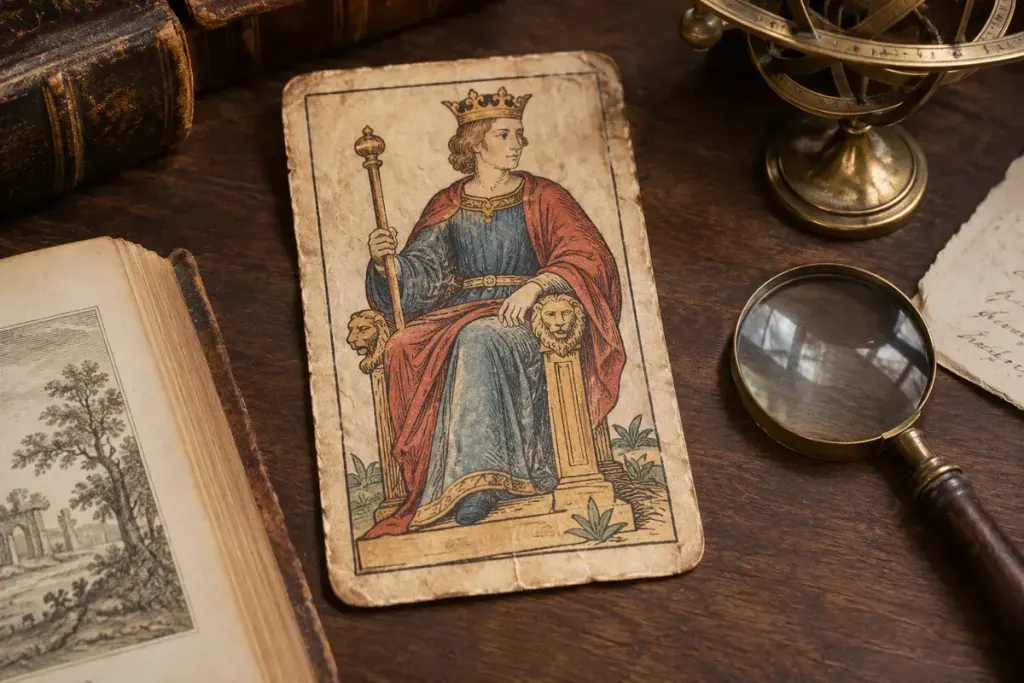
The deck’s appeal lies partly in interrupting recognition. Familiar names become invitations to examine a different visual solution, rather than shortcuts that let the eye skip the picture. The illustration accompanying this article is an imagined tarot-style image, not a reproduction of the historical cards.